

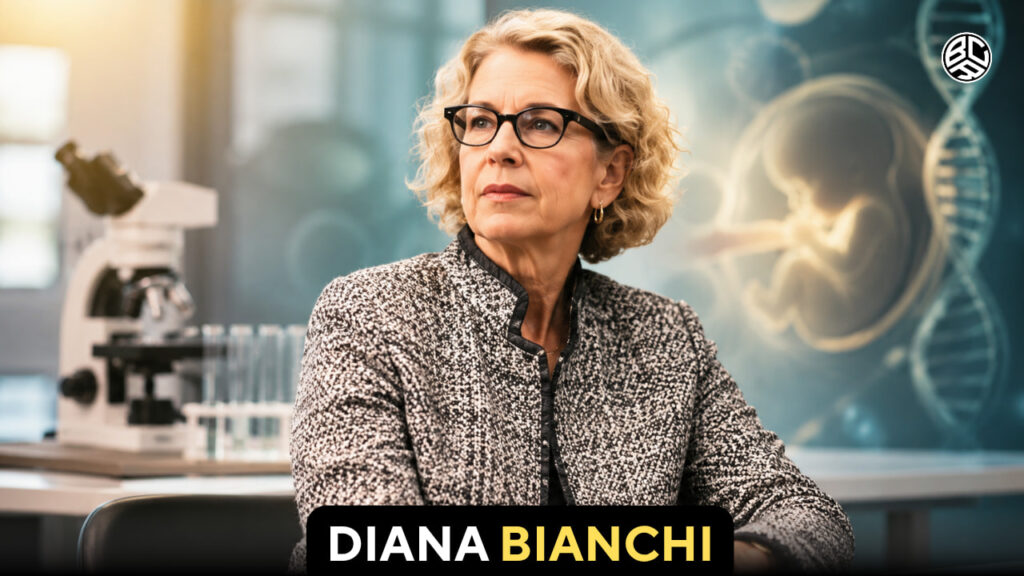
There are scientists whose work changes a field, and there are scientists whose work changes what it means to experience pregnancy. Diana W. Bianchi belongs firmly in the second category. As a medical geneticist and neonatologist whose career has spanned decades at some of America’s most prestigious medical institutions, she helped develop and advance the non-invasive prenatal testing that is now a routine part of prenatal care for families around the world.
Before her research and the work of scientists like her, detecting chromosomal conditions in a fetus often meant amniocentesis a procedure that involved inserting a needle into the uterus and carried a real risk of miscarriage. Today, many of those same screenings can be done through a simple blood draw. That shift represents one of the more significant improvements in prenatal medicine of the past few decades, and Bianchi’s contributions sit near the center of it.
Quick Summary
| Category | Details |
|---|---|
| Full Name | Diana W. Bianchi |
| Profession | Medical geneticist and neonatologist |
| Undergraduate | University of Pennsylvania (magna cum laude) |
| Medical Degree | Stanford University School of Medicine |
| Specialty Training | Harvard Medical School / Boston Children’s Hospital |
| Key Role | Director, NICHD at NIH (from 2016) |
| Research Focus | Non-invasive prenatal testing, fetal DNA, microchimerism |
Background and Education
Diana Bianchi grew up in New York City and attended Hunter College High School, one of the city’s most academically selective public schools. She went on to earn a Bachelor of Arts degree magna cum laude from the University of Pennsylvania before completing her M.D. at Stanford University School of Medicine.
At Stanford, her early research involved flow cytometry and prenatal diagnosis including work on Down syndrome testing which pointed toward the direction her career would take. She later completed specialty training at Harvard Medical School and Boston Children’s Hospital, building the clinical and research foundation that would underpin decades of work in maternal-fetal medicine.
The Science That Changed Prenatal Care
Non-Invasive Prenatal Testing (NIPT)
The contribution Diana Bianchi is most widely known for involves cell-free fetal DNA testing the technology behind what is now called non-invasive prenatal testing, or NIPT. The core insight is that small fragments of fetal DNA circulate in the mother’s bloodstream during pregnancy. By analyzing those fragments, it became possible to screen for chromosomal abnormalities most notably Down syndrome, but also trisomy 18 and trisomy 13 without performing any invasive procedure.
“Before NIPT, detecting chromosomal conditions meant risky invasive procedures. Bianchi helped create a world where a blood draw could do the same work safely.”
A landmark 2014 study published in The New England Journal of Medicine, which Bianchi was involved with, demonstrated that cfDNA testing produced fewer false positives and higher accuracy than older prenatal screening methods. That finding helped accelerate adoption of NIPT globally and reinforced the case for blood-based screening over invasive alternatives.
The practical impact for families has been substantial. A test that once required accepting a small but real risk of miscarriage can now be replaced, in many cases, by a blood sample taken during a routine prenatal appointment. For many expectant parents particularly those at higher risk of chromosomal conditions that shift has been genuinely significant.
Fetal Cell Microchimerism
A second major area of Bianchi’s research involves a phenomenon that is both scientifically fascinating and somewhat counterintuitive: fetal cells remain inside a mother’s body long after pregnancy ends, sometimes for decades. This field, known as fetal cell microchimerism, emerged partly from her work.
Her research suggested that these lingering fetal cells are not merely passive remnants. They may migrate to injured tissue, participate in healing processes, and interact with the mother’s immune system in ways that are still being studied. The implications extend beyond pregnancy itself into questions about maternal immune function and long-term health.
Leadership at the NIH
In 2016, Bianchi was appointed director of the Eunice Kennedy Shriver National Institute of Child Health and Human Development, one of the major research institutes within the National Institutes of Health. The role placed her at the head of a substantial research portfolio covering pediatric health, maternal health, reproductive medicine, developmental disabilities, and genomics.
Leading NICHD meant overseeing not just her own research agenda but the direction of a large federal research enterprise that funds and conducts studies affecting millions of people. It was a significant transition from bench science to science administration and one that required balancing deep expertise in a specific field with the broader responsibilities of managing a major public health institution.
In early 2025, reports indicated she was placed on administrative leave during broader federal staffing changes at NIH. The circumstances reflected the institutional disruptions affecting several federal science agencies during that period.
Recent Research: Prenatal Testing and Cancer Detection
One of the more striking recent developments in Bianchi’s research came in late 2024, when she and her NIH team published findings showing that prenatal DNA tests could sometimes incidentally detect cancer in pregnant women. The study attracted significant international attention because it opened up a new dimension for prenatal genomic testing beyond fetal health.
The idea is that cell-free DNA circulating in the bloodstream doesn’t only carry fetal genetic material it can also carry DNA from tumors. In some cases, the abnormal signals detected during routine prenatal screening were found to originate not from the fetus but from previously undiagnosed maternal cancers. Identifying those signals could, in theory, lead to earlier cancer diagnoses during pregnancy, a period when cancer detection is already more complicated.
It’s the kind of finding that demonstrates how technologies developed for one purpose can yield unexpected benefits in adjacent areas, and it extended the significance of Bianchi’s earlier prenatal testing work into a new clinical dimension.
Recognition and Awards
| Award / Recognition | Details |
|---|---|
| National Academy of Medicine | Elected member |
| Honorary Doctorate | University of Amsterdam |
| Forbes 50 Over 50 | Impact category |
| Neonatal Landmark Award | American Academy of Pediatrics |
| Service to America Medal | Finalist, 2022 |
These recognitions span both the scientific and public-impact dimensions of her career reflecting contributions that have been acknowledged by the medical research community and by broader audiences who track influential scientists working on problems that affect everyday people.
Conclusion
Diana Bianchi’s career is a study in what applied science can accomplish when it’s directed at a genuine human problem with sustained commitment over decades. The shift from invasive prenatal procedures to safe blood-based screening didn’t happen overnight, and it didn’t happen because of any single discovery. It happened because researchers like her kept working on the problem, refining the methods, publishing the evidence, and building the case for clinical adoption.
The result is a form of prenatal care that is meaningfully safer and more accessible than it was a generation ago. Families facing chromosomal screening decisions today have options that simply didn’t exist when this field was young. That’s a concrete, measurable improvement in human wellbeing, and Bianchi’s name belongs in the history of how it came about.
Her more recent work on prenatal testing and cancer detection suggests the scientific contributions aren’t finished yet which, given the trajectory of the past several decades, should surprise no one.
Sources: Wikipedia (Diana Bianchi), Society for Women’s Health Research, The New England Journal of Medicine (2014 cfDNA study). Career details and institutional affiliations reflect publicly available records as of mid-2025.
Discover Also Paul Patrow: Biography of a Leading Transactional Tax Attorney

M Adnan Akram is the founder and lead writer at Back Casting Room, where he covers celebrity biographies, family histories, and the lesser-known figures behind well-known names. His work focuses on separating verified public information from speculation, drawing on publicly available records, interviews, and credible reporting to build accurate, well-researched profiles.
With a particular interest in entertainment and pop culture, Adnan writes about everything from celebrity net worth breakdowns to the private individuals connected to famous names, the spouses, family members, and background figures whose stories rarely get told in full.
At Back Casting Room, the goal is straightforward: give readers accurate, well-sourced information without the clickbait or unverified claims that often surround celebrity-adjacent stories.