
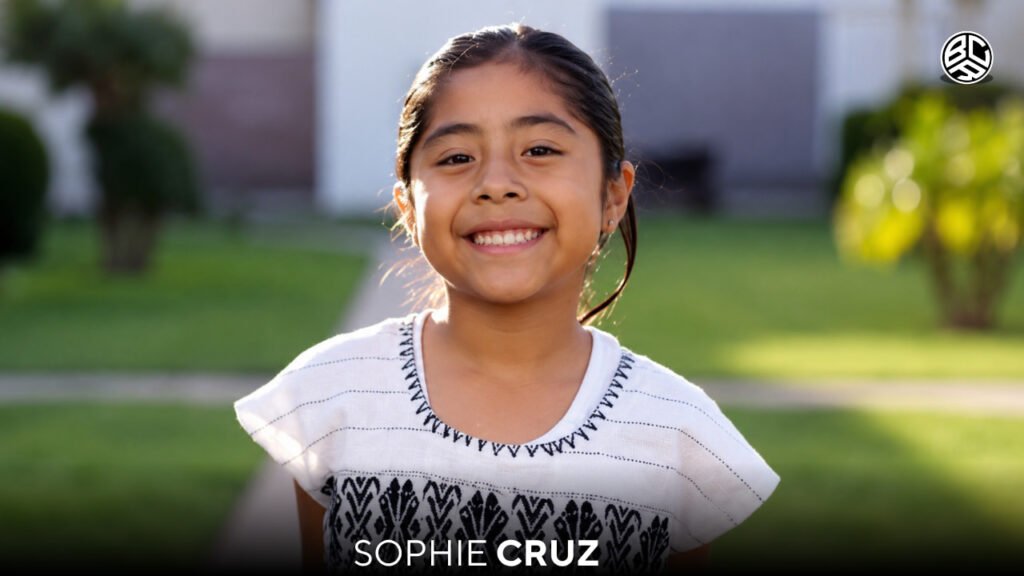
Some activists spend decades building a public platform before their message reaches the world. Others become symbols of a movement almost overnight, simply by being brave enough to speak up as children. That’s exactly what happened to Sophie Cruz, a girl who was only five years old when she became one of the most recognizable young faces in the American immigration rights movement.
Her story didn’t start with a rally or a press conference. It started with a letter, a handmade sign, and the courage to run toward a passing motorcade in the hope that someone powerful might actually listen.
Quick Summary
| Category | Details |
|---|---|
| Full Name | Sophie Cruz |
| Date of Birth | October 16, 2009 |
| Nationality | American |
| Known For | Immigration rights activism |
| Parents | Undocumented immigrants from Oaxaca, Mexico |
| Primary Cause | Advocacy for immigrant families and DAPA (Deferred Action for Parents of Americans) |
| Notable Recognition | Meeting Pope Francis in 2015 and becoming a national voice for immigration reform |
Who Is Sophie Cruz?
Sophie Cruz is an American immigration rights activist born on October 16, 2009. Her parents immigrated to the United States from Oaxaca, Mexico, without legal status, which meant that although Sophie herself was born a U.S. citizen, her family lived under the constant threat of separation through deportation.
That contradiction being a citizen while worrying that your own parents could be forced to leave the country became the emotional core of her activism. Rather than staying silent about it, she turned that fear into a public message aimed at the highest levels of political and religious leadership.
Growing Up With the Weight of Immigration Policy
Most children don’t think much about federal immigration law. Sophie’s early life looked different. Watching her parents live without legal status gave her a front-row seat to the real, human consequences of immigration enforcement consequences that policy debates in Washington often reduce to statistics and talking points.
That personal connection is part of why her message resonated so strongly with the public. She wasn’t repeating rehearsed political rhetoric. She was describing her own family’s reality.
The Moment That Made Her Famous
On September 23, 2015, Pope Francis visited Washington, D.C., and thousands of people lined the streets hoping for even a brief glimpse of him. Sophie had other plans. She wore a shirt reading “Papa Rescate DAPA” translating roughly to “Pope, Rescue DAPA” and carried a letter along with a drawing meant for the Pope himself.
As his motorcade passed, Sophie broke past the barriers and ran toward it. Security stepped in immediately, but Pope Francis noticed the small girl trying to reach him. He asked that she be brought closer, embraced her, and accepted her letter in front of a global audience of cameras and reporters.
The image spread almost instantly. A five-year-old girl who had just handed the leader of the Catholic Church a personal plea for her family became an overnight symbol of the immigration debate. The following day, Pope Francis addressed the U.S. Congress and called for greater compassion toward immigrants and refugees. He didn’t mention her by name, but many saw a clear connection between her gesture and his message.
Becoming a Voice for DAPA
Following that encounter, Sophie stepped into a more public advocacy role centered on the Deferred Action for Parents of Americans program, commonly known as DAPA. The Obama-era initiative was designed to let certain undocumented parents of U.S. citizens and lawful permanent residents remain in the country temporarily and legally work, without facing immediate deportation.
For a child, speaking about federal policy in front of cameras isn’t easy. Yet Sophie repeatedly described her fear of being separated from her parents, giving the abstract policy conversation a face and a voice that resonated with millions of families in similar situations.
A White House Invitation With a Bittersweet Twist
In May 2016, Sophie was invited to a Cinco de Mayo celebration at the White House, hosted during President Barack Obama’s administration. It should have been a proud family moment. Instead, it highlighted the very issue she’d been fighting against.
Because her parents remained undocumented, they weren’t able to enter the White House alongside her. Sophie attended with immigration advocates who had supported her work instead of with her own mother and father a quiet but powerful reminder of exactly what she was campaigning against.
Speaking at the Women’s March
On January 21, 2017, the day after President Donald Trump’s inauguration, Sophie took the stage at the Women’s March on Washington as one of its featured speakers. Standing before an enormous crowd, she called for compassion and unity, telling the audience, “Let us fight with love, faith and courage.”
The line was simple, but it captured attention across national and international media outlets. Coming from a child who had already spent years navigating public advocacy, it read less like a scripted talking point and more like a genuine appeal from someone who understood exactly what was at stake for families like hers.
Documentaries and Public Recognition
Sophie’s activism has been documented across several films and awareness campaigns over the years. She appeared in “Free Like the Birds,” a short film centered on her family’s story, and took part in “11 Million Stories,” an immigration awareness campaign produced alongside FWD.us. She was also featured in the 2018 documentary “This Is What Democracy Looks Like,” which focused on youth activism more broadly.
Her efforts haven’t gone unnoticed by advocacy organizations either. In 2017, she received Define American’s Activist of the Year Award, recognizing her contributions to the national immigration conversation. She has also been featured in educational exhibits and murals that celebrate young activists making an impact on social issues.
Why Her Story Still Matters
It would be easy to treat Sophie Cruz as a one-time viral moment, a memorable photo from 2015 that faded once the news cycle moved on. But her continued advocacy work shows that the moment was really just a starting point rather than the whole story.
She represents something larger than a single encounter with a religious leader. Her presence reminds people that immigration policy isn’t only about legislation and enforcement statistics; it’s about real families making impossible choices, and about children old enough to understand fear but too young to have any control over the systems shaping their lives.
Final Thoughts
Sophie Cruz’s journey from a five-year-old running toward a Papal motorcade to a recognized voice in the immigration reform movement shows how personal experience can shape public conversation in ways that policy briefings rarely manage. Her story isn’t just about one encounter with Pope Francis, it’s about the ongoing reality faced by countless mixed-status families across the country.
Whether she’s speaking to a crowd at the Women’s March or appearing in a documentary about youth activism, her message has remained consistent: families deserve compassion, and children shouldn’t have to fear losing their parents to deportation. That consistency is likely why, more than a decade after she first captured public attention, people still remember her name.
Discover Also Andrew Aldrin: The Man Carrying Forward a Space Legacy

M Adnan Akram is the founder and lead writer at Back Casting Room, where he covers celebrity biographies, family histories, and the lesser-known figures behind well-known names. His work focuses on separating verified public information from speculation, drawing on publicly available records, interviews, and credible reporting to build accurate, well-researched profiles.
With a particular interest in entertainment and pop culture, Adnan writes about everything from celebrity net worth breakdowns to the private individuals connected to famous names, the spouses, family members, and background figures whose stories rarely get told in full.
At Back Casting Room, the goal is straightforward: give readers accurate, well-sourced information without the clickbait or unverified claims that often surround celebrity-adjacent stories.