
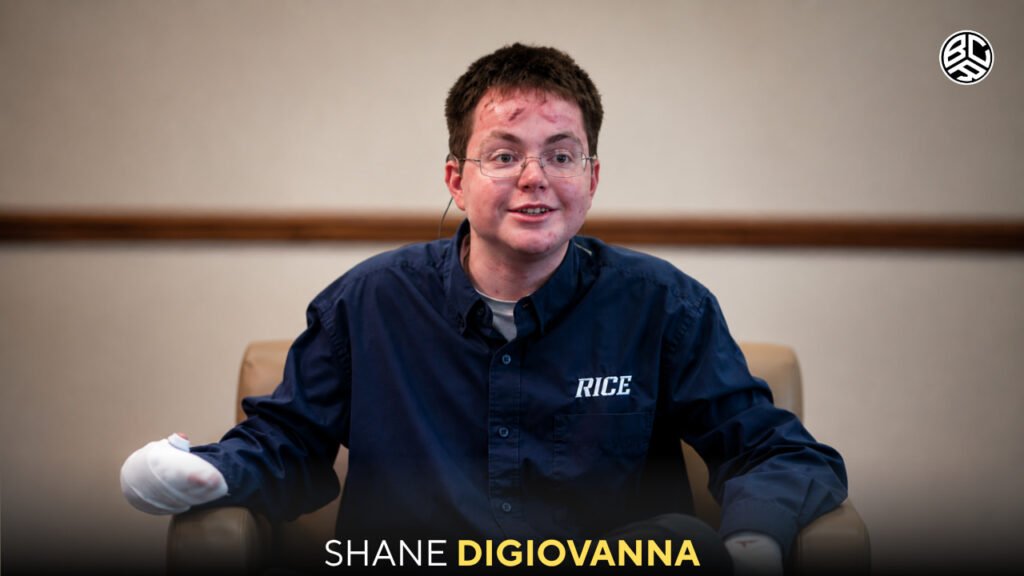
There is a particular kind of courage that does not look like courage from the outside, the kind that shows up every morning, manages an exhausting medical routine, and then goes to school and talks about the future of space colonization anyway. Shane DiGiovanna had that kind of courage.
He was born with Epidermolysis Bullosa, a rare genetic skin disorder so severe that it earned the name “butterfly skin disease” because his skin was as fragile as butterfly wings. EB causes the skin to blister and tear from the slightest friction or contact. It requires hours of daily wound care, careful bandaging, and a level of physical management that most people could not imagine sustaining through a single week, let alone a lifetime.
Shane DiGiovanna sustained it through childhood, through high school, through a TEDx talk about humanity’s future in space, through a high-altitude balloon project that reached 86,000 feet, and through a Rice University degree he earned with distinction.
His story is one of the more genuinely remarkable ones in the category of people who refused to be defined by their circumstances.
Quick Summary
| Category | Details |
|---|---|
| Full Name | Shane DiGiovanna |
| Nationality | American |
| Known For | Epidermolysis Bullosa (EB) advocacy, science education, disability awareness |
| Medical Condition | Epidermolysis Bullosa (EB) — a rare genetic disorder causing extremely fragile skin |
| Education | Rice University (Graduated in 2021) |
| Field of Interest | Science, space exploration, technology, rare disease advocacy |
| Advocacy Focus | Raising awareness for people living with EB and improving support for rare disease communities |
| Public Speaking | Featured as a TEDx speaker discussing space exploration and future human missions beyond Earth |
| Science Projects | Participated in a high-altitude balloon project that reached the upper atmosphere for scientific research |
| Organization Connections | Associated with rare disease awareness efforts and Cincinnati Children’s Hospital Medical Center |
| Achievements | Academic honors, science projects, disability advocacy work |
| Personality/Legacy | Remembered for resilience, curiosity, and using his experiences to inspire others |
| Career Path | Science and technology-focused interests; detailed professional career information is limited |
| Public Recognition | Known within disability advocacy and science communities |
| Social Media Presence | Limited verified public information available |
Understanding Epidermolysis Bullosa
Before exploring who Shane was and what he built, it is worth pausing to understand the condition he lived with because without that context, his achievements do not fully register.
Epidermolysis Bullosa is a group of rare genetic disorders in which the skin lacks the proteins that hold its layers together. For people with severe forms of EB, everyday activities that most people do without thinking about putting on a shirt, walking, and turning over in bed can cause blisters and wounds. The condition is not contagious, not caused by lifestyle choices, and not curable. It is present from birth and managed, with significant effort, for life.
Daily care for someone with severe EB typically involves several hours of wound treatment, specialized dressings, and ongoing monitoring. The physical pain is real and chronic. The emotional weight of managing a body that requires constant attention is significant.
Shane lived with this from the day he was born, in the United States, navigating a healthcare and accessibility landscape that does not always account for the needs of people with rare and complex conditions.
And he decided at a young age, by all available accounts, that his condition was not going to be the most interesting thing about him.
Growing Up With a Scientific Mind
The details of Shane DiGiovanna’s early childhood are not extensively documented in public sources, but the trajectory that emerges from what is known is consistent: he was a young person with a powerful intellectual curiosity, particularly around science and space.
His interest in space exploration was not casual. It was the kind of deep, sustained fascination that led a high school student to give a TEDx talk on the subject which Shane did, at TEDx Cincinnati, presenting his ideas about space colonization and humanity’s future beyond Earth to a live audience.
A TEDx talk requires research, structure, and the confidence to present complex ideas to people who have come specifically to be stimulated by the best thinking a speaker can offer. For a teenager living with a condition that makes daily physical existence demanding, standing on that stage represented both intellectual achievement and physical determination.
The talk was about looking outward at planets and possibilities and the long future of the species. It is hard not to read that interest in the context of his own experience: a person who understood viscerally what it meant to face significant constraints choosing to spend his intellectual energy on the question of what becomes possible when we push beyond what seems reachable.
The High-Altitude Balloon Project
One of the more specific and vivid achievements documented in Shane’s story is a high-altitude balloon project that he worked on sending scientific instruments and cameras up to approximately 86,000 feet.
For context: commercial airliners typically cruise between 30,000 and 40,000 feet. At 86,000 feet, a balloon is in the stratosphere, well above nearly all of Earth’s weather systems, floating at the edge of what we would recognize as sky.
Getting a scientific payload to that altitude is not a trivial undertaking. It requires planning, payload design, launch logistics, and the kind of methodical scientific thinking that does not come from passive interest. It comes from genuine engagement with how things work and why.
This project is exactly the kind of thing that reveals who a person actually is when they have the freedom to pursue what matters to them. Shane chose to build something that could reach the edge of space metaphorically and almost literally.
Rice University and Academic Achievement
Shane DiGiovanna graduated from Rice University in 2021 as a member of the class that navigated the final stretch of their undergraduate years through a global pandemic, a context that added yet another layer of challenge to a life that already had plenty.
At Rice, he was recognized as a Distinguished Senior and was a member of the Cum Laude Society academic honors that speak to sustained excellence across his undergraduate career.
Rice University is a selective research institution in Houston, Texas, with particular strength in science and engineering. It attracts students with genuine intellectual drive, and it does not award honors like Distinguished Senior for showing up; it requires demonstrating real contribution and achievement.
That Shane earned those recognitions while managing the daily demands of severe EB is a fact worth sitting with. The medical routine alone would be enough to derail most people’s academic focus. He built an academic record of genuine distinction on top of it.
Advocacy, Cincinnati Children’s Hospital, and the Shane DiGiovanna Act
Alongside his scientific pursuits, Shane was connected to advocacy work focused on improving life for people with EB and other rare diseases.
He worked with Cincinnati Children’s Hospital Medical Center, one of the country’s leading pediatric hospitals and a center of excellence for rare disease research. His connection to that institution placed him within a community of physicians, researchers, and patients navigating the same landscape he knew from personal experience.
One of the more significant developments connected to his legacy is the proposed Shane DiGiovanna Act legislative efforts discussed in disability and rare disease communities aimed at reducing costs of medical supplies for people living with EB. Specialized wound care products for EB patients are extraordinarily expensive, and accessibility to them is a genuine barrier for many families.
The fact that his name became attached to proposed legislation that his life and advocacy carried enough weight to be the framing for a policy conversation reflects how seriously the people around him took what he was trying to do.
Medical supplies that cost thousands of dollars a month for a condition that is present from birth and never goes away are not a niche policy question. They are a quality-of-life question for thousands of Americans and their families. Shane understood this from the inside, and he worked to make the conversation about it louder.
What Shane DiGiovanna Represented
There is a version of disability stories that the public tends to be comfortable with: the person who overcomes, who achieves despite, whose narrative has a triumphant arc that makes the audience feel good about what is possible. Those stories are real, and they matter.
But Shane’s story is more complex and more honest than that arc. He did not overcome EB. He lived with it every day, through constant pain, through an exhausting medical routine, through a body that required more care than most people’s bodies require. He did not transcend his condition. He carried it while doing other things simultaneously: dreaming about space, building balloons, earning academic honors, advocating for people who needed better policies.
That is a different kind of story. It does not ask you to be inspired that someone with a disability managed to do impressive things. It asks you to recognize that impressive things are being done inside lives that are harder than most people can imagine and that the systems and policies surrounding those lives matter enormously.
His advocacy was not separate from his scholarship or his scientific curiosity. All of it was connected, driven by someone who understood both what was possible and what needed to change.
Conclusion
Shane DiGiovanna was a young American who lived with one of the most painful rare conditions on record and spent his energy thinking about the future of humanity in space, launching scientific payloads into the stratosphere, earning distinction at a selective research university, and working to change policies that made life harder for people like him.
He is remembered in hospital corridors, in rare disease communities, and in the proposed legislation that carries his name as someone who turned a difficult life into a platform for something larger.
The balloon he launched reached 86,000 feet. The ideas he carried went further.
Discover Also Cara Kennedy Cuomo: The Attorney Who Quietly Chose Her Own Path

M Adnan Akram is the founder and lead writer at Back Casting Room, where he covers celebrity biographies, family histories, and the lesser-known figures behind well-known names. His work focuses on separating verified public information from speculation, drawing on publicly available records, interviews, and credible reporting to build accurate, well-researched profiles.
With a particular interest in entertainment and pop culture, Adnan writes about everything from celebrity net worth breakdowns to the private individuals connected to famous names, the spouses, family members, and background figures whose stories rarely get told in full.
At Back Casting Room, the goal is straightforward: give readers accurate, well-sourced information without the clickbait or unverified claims that often surround celebrity-adjacent stories.