

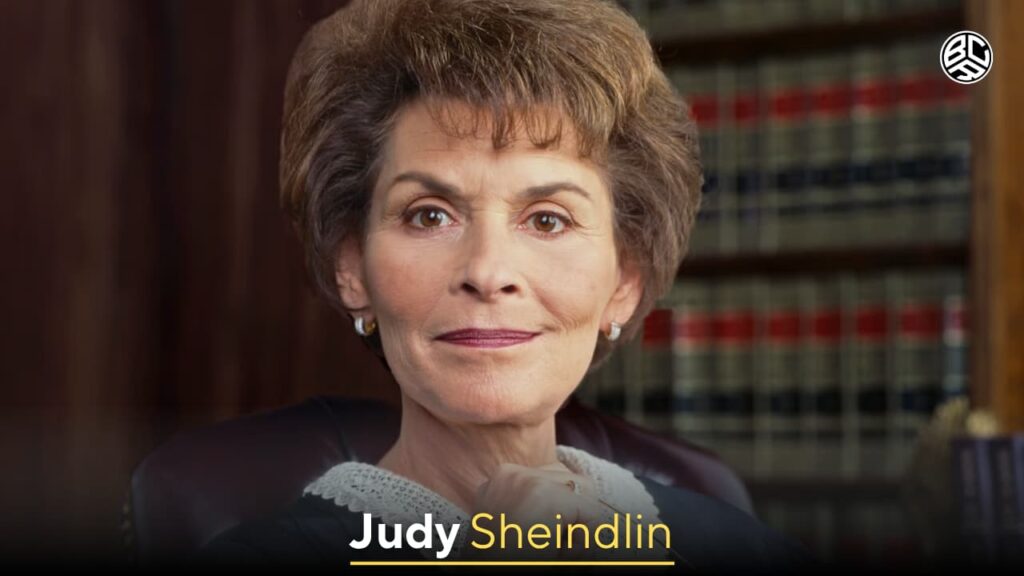
If you typed “Judy Schelin” into a search bar, you already know who you’re looking for but the name you typed probably isn’t quite right. The person behind that search is almost certainly Judy Sheindlin, better known to the world as Judge Judy: the sharp-tongued, no-nonsense television judge who spent 25 seasons dispensing common sense and courtroom rulings to millions of viewers across America.
The misspelling is so common it’s practically its own phenomenon. And understanding why it happens as well as who Judy Sheindlin actually is makes for a genuinely interesting story about a woman who turned a career in family court into one of the most remarkable television legacies in broadcast history.
Who Is Judy Sheindlin?
Judith Susan Sheindlin was born on October 21, 1942, in Brooklyn, New York. She grew up in a Jewish household, studied law, and built a career in the New York legal system before anyone outside of Manhattan’s family courts had any idea who she was.
After graduating from law school, she became a family court prosecutor in New York in 1972 working in one of the most emotionally demanding corners of the legal system, where the cases involve children, broken families, abuse, and neglect. It’s not glamorous work, and it requires a particular combination of toughness and compassion to do it well for any length of time.
She did it well enough that in 1982, New York City Mayor Ed Koch appointed her as a family court judge. Four years later, she was promoted to supervising judge overseeing the work of other judges in the family court system.
Her profile began to rise in the early 1990s when she appeared in a 60 Minutes profile that introduced her blunt, impatient, refreshingly honest approach to a national audience. Viewers responded immediately to someone who said what she thought without the diplomatic hedging that most public officials perform as second nature.
The Judge Judy Years
In 1996, Judge Judy premiered on syndicated television, and what followed was one of the most sustained successes in daytime TV history.
The show ran for 25 seasons, an almost unthinkable run by the standards of any television format. During that time, it became the highest-rated daytime court show in the history of American television, and Judy Sheindlin became one of the highest-paid personalities on TV, reportedly earning around $47 million per year at the peak of the show’s run.
What made the show work wasn’t the cases of small claims disputes, neighbor conflicts, family disagreements that the format resolved in roughly twenty minutes. What made it work was her. Sheindlin’s ability to cut through evasion, detect dishonesty, and deliver judgment with both clarity and dry humor created a viewing experience that felt more like watching a master class in human nature than a legal proceeding.
She holds a Guinness World Record for the longest-serving TV courtroom arbitrator, and in 2019 she received a Lifetime Achievement Emmy recognition that her industry peers placed her work in the same category as careers that shaped television itself.
Judge Judy ended its run in 2021, but Sheindlin returned quickly with Judy Justice, a new courtroom show that demonstrated she had no interest in retirement.
Why “Judy Schelin” Is Such a Common Misspelling
The name “Sheindlin” is genuinely difficult for English speakers, and the reasons for that are worth understanding rather than just dismissing.
It Has Yiddish and Hebrew Origins
The surname Sheindlin comes from Ashkenazi Jewish naming traditions. It derives from “Sheindl” or “Sheindel,” a Yiddish name meaning “beautiful” itself related to the German word schön. The suffix “-lin” or “-in” indicates descent, so the name roughly translates to “descendant of Sheindl.”
This etymology is interesting in itself, but it also explains why the spelling feels counterintuitive to English speakers. The name follows the phonetic and orthographic conventions of Yiddish rather than English, which means the instinct to “write what you hear” produces something that doesn’t match the actual letters.
The Pronunciation Doesn’t Map to the Spelling
Sheindlin is typically pronounced something like “SHANE-dlin” or “SHINE-dlin.” When people try to write that sound down, they produce variations like “Sheinlin,” “Sheindlen,” or most commonly something like “Schelin” or “Shindlin.” The compression of the name into something more pronounceable in English just naturally produces errors.
Historical Spelling Variants Add to the Confusion
Ashkenazi Jewish surnames went through enormous variation across history as families moved across Europe, between alphabets, and through immigration processes that often transcribed names phonetically in whatever language the intake officer happened to speak. Variants like Sheindlein, Sheyndlin, and Sheindelman all exist in historical records.
That variation means there was never one firmly established “correct” spelling burned into cultural memory making it easier for each person who encounters the name to unconsciously construct their own version.
Confusion With Other Names
There’s an additional layer of confusion that comes from similarity to other names. Shira Scheindlin is a well-known U.S. federal judge whose surname sounds similar and is spelled differently. For anyone who has encountered both names, the overlap creates an additional source of uncertainty about which spelling belongs to which person.
The nickname “Judge Judy” hasn’t helped the situation. Most people know her by those two words alone, and when they eventually need to write her full surname, they’re essentially reconstructing it from memory without a solid foundation to build from.
A Legacy Beyond Television
It would be easy to reduce Judy Sheindlin’s story to the television show, but doing so undersells what came before it. She spent more than two decades in New York’s family court system first as a prosecutor, then as a judge, then as a supervising judge doing genuinely difficult work in one of the most challenging areas of the law.
The television show was built on that foundation. The reason viewers trusted her judgment, responded to her directness, and came back for 25 seasons wasn’t because she was a TV personality who had learned to seem authoritative. It was because she actually was authoritatively trained by decades of real cases, real families, and real consequences.
Her willingness to engage in the entertainment world on her own terms, to remain recognizably herself rather than performing a softened version of her personality for the cameras, is what separated Judge Judy from the dozens of courtroom shows that tried to replicate its success and fell short.
Conclusion
Whether you arrived here searching for “Judy Schelin,” “Shindlin,” or some other variation, the person you were looking for is Judy Sheindlin attorney, judge, television institution, and one of the most recognizable legal personalities in American media history.
The misspelling is understandable. The name carries the history of Yiddish naming conventions, European migration, and phonetic translation across multiple languages, none of which makes it easy for English speakers to write from memory. Now that you know the correct spelling and the story behind it, you’re unlikely to get it wrong again.
And if you haven’t spent time watching her work either the original run or the current Judy Justice it’s worth finding out what twenty-five years of viewers already knew.
Discover Also Edmund D’Alto: Biography, Family, and Everything Publicly Known

M Adnan Akram is the founder and lead writer at Back Casting Room, where he covers celebrity biographies, family histories, and the lesser-known figures behind well-known names. His work focuses on separating verified public information from speculation, drawing on publicly available records, interviews, and credible reporting to build accurate, well-researched profiles.
With a particular interest in entertainment and pop culture, Adnan writes about everything from celebrity net worth breakdowns to the private individuals connected to famous names, the spouses, family members, and background figures whose stories rarely get told in full.
At Back Casting Room, the goal is straightforward: give readers accurate, well-sourced information without the clickbait or unverified claims that often surround celebrity-adjacent stories.