

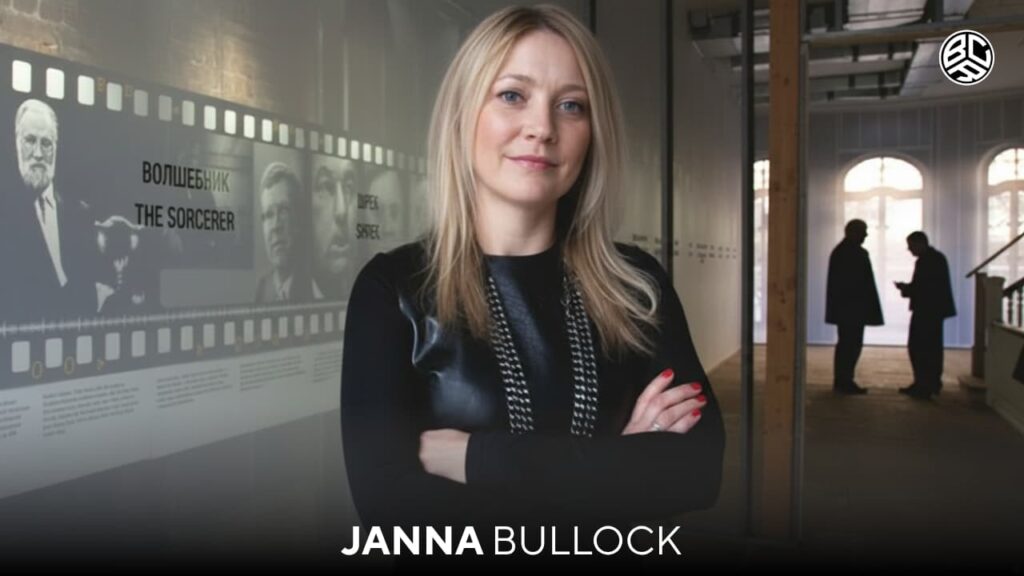
Not many people move from the Soviet Union to the United States with little more than ambition and end up reshaping skylines on two continents. Janna Bullock did exactly that. From babysitting jobs and paralegal work to running a multi-billion-dollar real estate empire, her story reads less like a conventional business biography and more like an old-fashioned tale of reinvention one that happens to involve Manhattan townhouses, Russian oligarchs, and some of the most celebrated art collections in the world.
She is polarizing. Celebrated in design circles and art institutions, she has also faced serious legal accusations that continue to cast a long shadow.Understanding who Janna Bullock really is requires looking at both sides of that story.
Quick Table
| Category | Details |
| Profession | Real estate developer, investor, art collector |
| Company | Founder of RIGroup |
| Origin | Russia; moved to the U.S. in 1989 |
| Education | MBA from Duke University |
| Known For | Luxury real estate and historic restoration |
| Art Role | Collector; former board member of Solomon R. Guggenheim Foundation |
| Net Worth | ~$2 billion (self-reported in media; not independently verified) |
| Relationships | Previously married to Alexei Kuznetsov |
| Legal Status | Sentenced in absentia in Russia (2018) |
| Position | Denies allegations |
From Moscow to Manhattan: An Unlikely Beginning
Bullock was born in Russia and grew up during the Soviet era, an upbringing that, by her own account, gave her a deep appreciation for beauty, culture, and the kind of stability that material success can provide. She came to the United States in 1989, at a time when the Soviet Union was crumbling and the opportunities ahead were anything but clear.
Her early years in America were far from glamorous. She worked as a babysitter, then as a paralegal practical jobs that paid the bills while she figured out her footing in a new country. What she had, though, was an intellectual foundation rooted in language, literature, and philosophy. That background, unusual for a real estate developer, would later show up in the way she approached design and space.
She eventually earned an MBA from Duke University, and from there, her trajectory changed dramatically. Real estate became the vehicle through which she would channel everything: her aesthetic sensibility, her business instincts, and her appetite for scale.
Building RIGroup and a Reputation for Luxury
Bullock founded RIGroup, a real estate investment and development firm that became her primary vehicle for building wealth. The company focused on luxury residential properties, commercial developments, and the restoration of historic buildings, a niche that played perfectly to her strengths.
Her early work in New York City, particularly on Manhattan’s Upper East Side, put her on the map. She would buy rundown townhouses, oversee their transformation, and sell them for significant profit. These were not quick flips. The renovations were meticulous, often involving custom finishes, natural materials, and an interior philosophy centered on calm, harmony, and what she described as “zen-like” design. The results attracted serious buyers and serious attention.
Her work was not confined to the United States. RIGroup expanded into Russia, the United Kingdom, and continental Europe. At its peak, the company reportedly managed millions of square feet of development space, particularly in the Russian market, where demand for high-end property was surging during the 2000s oil boom.
A Design Philosophy That Set Her Apart
What distinguished Bullock from many developers was that she cared deeply about what a finished space felt like to live in. She spoke frequently about the relationship between art, architecture, and interior design, seeing them not as separate disciplines but as parts of a single experience. Her projects often blurred the line between a residence and a curated environment, with natural light, organic materials, and considered proportions at the center of every decision.
This approach made her a respected voice in design and architecture circles, and it brought her into close orbit with the art world, a space she would come to occupy with equal ambition.
An Art Patron With Global Reach
Beyond real estate, Bullock built a reputation as a significant art collector and cultural patron. She reportedly assembled a collection of thousands of works, with a particular focus on Russian artists, a reflection of both her personal heritage and her belief in the cultural richness of that tradition.
She organized international art exhibitions and design showcases, helping to bring Russian contemporary art to broader audiences. Her involvement extended to institutional philanthropy she served on the board of the Solomon R. Guggenheim Foundation, one of the most prestigious positions in the international art world. That kind of role is not given to casual enthusiasts; it signals sustained engagement and genuine credibility within the cultural establishment.
For Bullock, art and property were never entirely separate worlds. Both involved vision, patience, and the ability to see potential where others might not. The same instinct that led her to restore a deteriorating townhouse on the Upper East Side drove her to champion artists whose work had not yet found its audience.
The Scale of Her Success
In a 2012 interview, Bullock reportedly valued her real estate holdings at approximately $2 billion. It is worth noting that this figure came from her own statements and media coverage rather than independently audited sources, so it should be treated as an approximation rather than a verified number. Still, even accounting for that caveat, the scale of what she built across New York, Russia, and Europe represents a remarkable commercial achievement for someone who arrived in the United States with little in the way of capital or connections.
Her success during the 2000s placed her among a generation of Russian-born entrepreneurs who leveraged the economic chaos of post-Soviet transition into significant international wealth though unlike many of her contemporaries, her focus was always on building and creating rather than purely on financial extraction.
Legal Troubles and a Contested Case
The most consequential chapter of Bullock’s public story involves serious criminal accusations originating in Russia. In 2018, a Moscow court sentenced her in absentia to eleven years in prison on charges of embezzling nearly $200 million from government-related funds.
She has consistently denied any wrongdoing. Her position is that the case against her is politically motivated, an example of what she calls “wrongful corporate raiding,” a practice in which powerful interests use legal mechanisms to seize assets from successful businesspeople. This kind of accusation is not uncommon among Russian emigres who have fallen out of favor with powerful domestic interests, and it makes the case difficult to evaluate from the outside.
U.S. authorities reportedly declined Russia’s extradition request, which means she has continued to live and work in the United States throughout the legal process. There have also been other reported disputes, civil lawsuits related to property charges and art ownership claims though not all of these allegations have been fully adjudicated in accessible public records, so they deserve cautious interpretation.
What is clear is that the legal situation in Russia has significantly shaped how the public story of this developer has been told, often overshadowing the substantial business and cultural contributions that came before.
A Legacy Written in Stone and Canvas
It is difficult to write about Janna Bullock without holding two very different images in mind at once. On one side: a self-made woman who turned a passion for beautiful spaces into a global business, championed Russian art on the international stage, and earned a seat at the table of some of the world’s most respected cultural institutions. On the other: a figure at the center of serious financial accusations whose full truth remains contested and unresolved.
What her career undeniably demonstrates is the kind of ambition and vision that transforms industries. The luxury real estate model she helped popularize where a property is not just a place to live but an experience, a piece of art in its own right has become standard practice in high-end development worldwide. Her influence on how developers think about design, materials, and the intersection of living spaces with culture is real and lasting.
Conclusion
Janna Bullock’s story is one that resists simple conclusions. She is neither purely a success story nor a cautionary tale she is both, simultaneously, depending on which chapter you are reading. What is beyond dispute is that she built something substantial: a development firm with global reach, a collection of art that spans thousands of works, and a design philosophy that changed how luxury property is conceived and sold.
Whether her full legacy is ultimately defined by the buildings she restored or the legal battles she has faced, she remains one of the most fascinating and genuinely complex figures to have emerged from the post-Soviet wave of international entrepreneurship. Her story is far from over, and whatever verdict history ultimately renders, it will not be a simple one.
Discover Also Erika Kirk Leather Pants: The Viral Fashion Moment

M Adnan Akram is the founder and lead writer at Back Casting Room, where he covers celebrity biographies, family histories, and the lesser-known figures behind well-known names. His work focuses on separating verified public information from speculation, drawing on publicly available records, interviews, and credible reporting to build accurate, well-researched profiles.
With a particular interest in entertainment and pop culture, Adnan writes about everything from celebrity net worth breakdowns to the private individuals connected to famous names, the spouses, family members, and background figures whose stories rarely get told in full.
At Back Casting Room, the goal is straightforward: give readers accurate, well-sourced information without the clickbait or unverified claims that often surround celebrity-adjacent stories.