

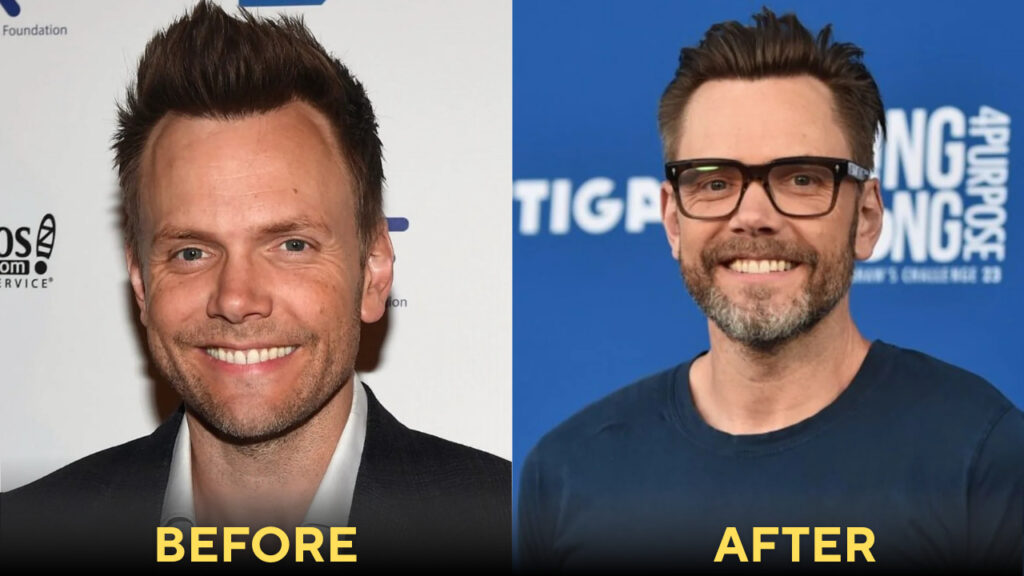
Most celebrities stay quiet about cosmetic procedures. Joel McHale is not a celebrity. The actor and comedian best known for Community and The Soup has been unusually open about his hair restoration journey confirming not just that he had work done, but how many times, how much it cost, which techniques he used, and what his hair would look like without any of it.
The short version? He said he’d be “fully bald” without the procedures. The longer version is considerably more interesting.
Clearing Up the “Implants” Question
A lot of people search for Joel McHale hair implants, and it’s worth clarifying what that term actually means in this context. “Hair implants” is a phrase many people use casually to describe any kind of hair restoration procedure but technically, what McHale described are hair transplants, which are a different thing.
Hair transplants involve moving real hair follicles from one part of the scalp (typically the back or sides, where hair is genetically resistant to loss) to areas that are thinning or receding. The result is natural hair growing from transplanted roots not synthetic material or cosmetic implants.
McHale confirmed four separate transplant procedures over the years. That number alone is higher than what most people discuss publicly, and his candor about the whole process has made him a surprisingly useful reference point for anyone researching these procedures.
What Joel McHale Said About His Hair Transplants
McHale discussed the procedures openly on the We Might Be Drunk podcast, and the conversation covered more detail than celebrity hair discussions usually do.
He said he underwent four procedures in total, using different techniques across those surgeries. He described his earlier procedures as using the strip method medically known as FUT (Follicular Unit Transplantation) and said they were painful. He advised against them, specifically flagging the discomfort as a reason to look into newer options instead.
His later procedures used the FUE method Follicular Unit Extraction where individual follicles are removed one by one rather than cutting out a strip of scalp. McHale reportedly called this approach a “miracle” by comparison.
He also mentioned spending approximately $10,000 total across all four procedures, though he acknowledged that pricing may have shifted since some of his earlier surgeries were done years ago.
FUT vs FUE: Why the Method Matters
Since McHale specifically distinguished between the two techniques, it’s worth understanding what makes them different.
FUT (Strip Method)
This is the older approach. A strip of scalp is surgically removed from the donor area, typically at the back of the head. The follicles are then extracted from that strip and transplanted. It leaves a linear scar, recovery tends to be more involved, and McHale’s description of it as painful aligns with how many patients recall the experience.
FUE (Follicular Unit Extraction)
This is the more modern technique. Each follicle is individually extracted using a small punch tool, leaving tiny dot-shaped marks rather than a linear scar. Recovery is generally faster, scarring is less visible, and patient satisfaction scores tend to be higher. It’s the direction the industry has moved in recent years, and McHale’s enthusiasm for it fits that broader trend.
Why Four Procedures?
This is actually the most educational part of what McHale shared. Many people assume a single hair transplant is a permanent fix. McHale explained an important nuance: transplanted hair does stay permanently, but the surrounding natural hair can continue thinning over time.
That means someone who gets one procedure in their 30s may find that the hair around the transplanted area keeps receding, eventually creating gaps or an uneven look. A second or third, or fourth procedure addresses those new areas of loss.
It’s not that the first surgery failed. It’s that hair loss is an ongoing process, not a single event.
Fans had noticed the changes over the years across McHale’s television work, with earlier appearances showing more visible recession and later ones showing a fuller, more consistent hairline. Reddit threads had speculated about restoration work long before he confirmed it, which he eventually did, on his own terms, with a level of detail that most celebrities never provide.
Conclusion
What makes Joel McHale’s disclosure genuinely useful beyond celebrity gossip is the specificity. Four procedures. Two different techniques. A rough cost figure. A clear explanation of why multiple surgeries can be necessary. And a direct recommendation to avoid older strip methods in favor of modern extraction approaches.
For anyone researching hair transplants, that’s a more honest account than most public figures ever offer. Whether the curiosity comes from following his career or from a personal interest in restoration options, his willingness to talk about it openly has turned what could have been a tabloid footnote into something genuinely informative.
Check this: href
All details in this article are based on McHale’s own public statements. For medical advice on hair restoration, consult a licensed dermatologist or hair restoration specialist.
Discover Also Gwyneth Paltrow Before, After : What She’s Confirmed and What Remains Speculation

M Adnan Akram is the founder and lead writer at Back Casting Room, where he covers celebrity biographies, family histories, and the lesser-known figures behind well-known names. His work focuses on separating verified public information from speculation, drawing on publicly available records, interviews, and credible reporting to build accurate, well-researched profiles.
With a particular interest in entertainment and pop culture, Adnan writes about everything from celebrity net worth breakdowns to the private individuals connected to famous names, the spouses, family members, and background figures whose stories rarely get told in full.
At Back Casting Room, the goal is straightforward: give readers accurate, well-sourced information without the clickbait or unverified claims that often surround celebrity-adjacent stories.