
When the Cuban Missile Crisis brought the world to the edge of nuclear war in October 1962, the eyes of American military planners were fixed on Guantanamo Bay, one of the most strategically exposed and symbolically significant U.S. military installations in the world. It sat on Cuban soil, surrounded by a hostile government, separated from the naval blockade by open water, and staffed by thousands of American service members who had no way out if things turned catastrophic.
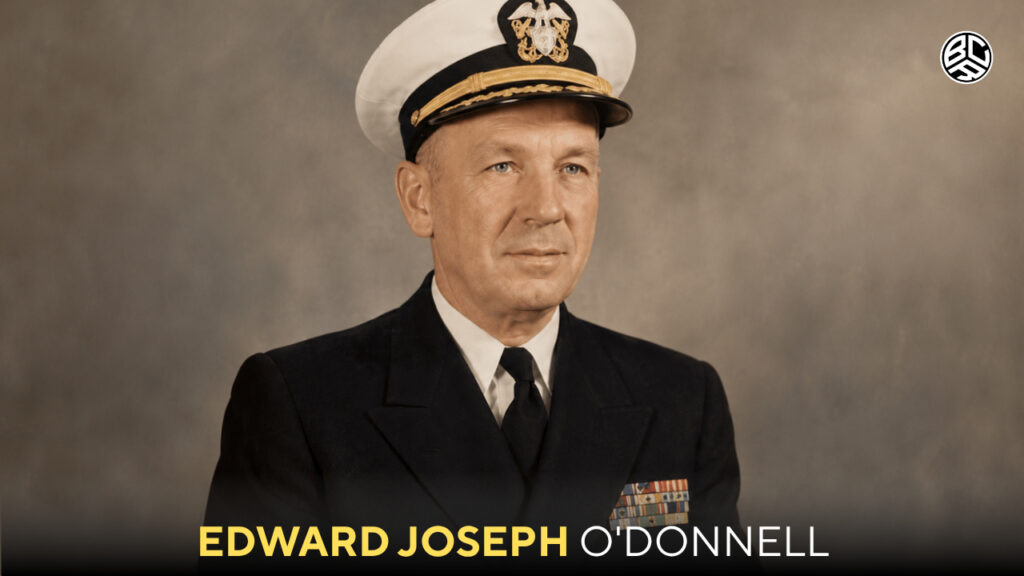
The man commanding that installation was Rear Admiral Edward J. O’Donnell, and understanding his career is understanding one of the Cold War’s most remarkable military assignments at one of its most dangerous moments.
Quick Fact
| Field | Details |
|---|---|
| Full Name | Edward J. O’Donnell |
| Profession | U.S. Navy Rear Admiral |
| Nationality | American |
| Born | April 13, 1907 |
| Died | December 9, 1991 |
| Education | United States Naval Academy (Class of 1929) |
| Military Branch | United States Navy |
| Years of Service | Approximately 42 years |
| Highest Rank | Rear Admiral |
| Major Wars/Conflicts | World War II, Korean War, Cold War |
| Most Notable Role | Commander of Guantanamo Bay during the Cuban Missile Crisis |
| Other Major Position | Superintendent of the Naval Postgraduate School |
| Retirement | 1967 |
| Known For | Cold War naval leadership and strategic military command |
From Annapolis to the Pacific: Building a Naval Career
Born on April 13, 1907, O’Donnell grew up in an era when the United States Navy was transitioning from the age of battleships into the beginnings of modern naval aviation and global power projection. He earned his place in that world by graduating from the United States Naval Academy at Annapolis in 1929, entering the fleet as an ensign during a period when the Navy was expanding its capabilities and beginning to develop the doctrines that would carry it through the conflicts ahead.
The 1930s were his formative years as an officer, sea duty assignments, ship command experience, the gradual accumulation of the practical naval knowledge that separates career officers from career administrators. He was part of a generation of naval officers shaped by peacetime readiness who would be tested by the real thing.
When World War II arrived, O’Donnell served in the Pacific theater, participating in naval operations against Japan in one of the most complex and geographically vast maritime conflicts in history. The Pacific War demanded logistical sophistication, command coordination, and operational endurance on a scale that had no precedent in American military history. His service in that theater confirmed his trajectory toward senior command.
The Korean War Era and the Path to Flag Rank
Following World War II, O’Donnell continued his career through the Korean War period, holding increasingly senior positions as the Navy restructured itself for the Cold War environment. The shift from wartime to Cold War footing required a different kind of military thinking less about immediate combat and more about sustained readiness, global positioning, and the management of deterrence.
It was during this period that he rose to flag rank, earning the title of Rear Admiral a designation reserved for the Navy’s senior leadership and indicating an officer trusted with significant operational and strategic responsibility.
The decades between World War II and the Cuban Missile Crisis were formative ones for American military strategy. The development of nuclear weapons, the emergence of the Soviet Union as a peer military competitor, and the escalating tensions of the Cold War all reshaped what it meant to command American military forces. O’Donnell’s career ran directly through all of it.
The Guantanamo Command: America’s Most Exposed Base
The assignment that would define O’Donnell’s historical legacy was his command of the U.S. Naval Base at Guantanamo Bay, Cuba.
Guantanamo occupies a unique and genuinely strange position in American military history. The United States has operated the base on Cuban soil since 1903, maintaining a lease that the Cuban government under any political configuration has never been able to simply terminate. After Fidel Castro came to power, the base became an island of American military presence surrounded by a government that was actively hostile, increasingly aligned with the Soviet Union, and deeply interested in seeing the Americans leave.
As commander, O’Donnell managed not just the operational aspects of running a major naval installation but the extraordinary political and strategic complexity of doing so in one of the most contested pieces of geography in the Western Hemisphere.
April 1961: The Bay of Pigs
The first major test of his Guantanamo command came with the Bay of Pigs invasion in April 1961. The CIA-sponsored attempt to overthrow Castro using Cuban exiles failed catastrophically, and the aftermath significantly raised tensions between Cuba, the United States, and the Soviet Union.
For the commander at Guantanamo, the Bay of Pigs raised immediate questions about the base’s security. The invasion’s failure had not removed Castro, it had humiliated the United States and given the Cuban government both a propaganda victory and increased incentive to view the base as a threat. Managing readiness at Guantanamo after the Bay of Pigs required both military judgment and careful attention to signals that could be misinterpreted by a nervous adversary.
October 1962: Thirteen Days at the Edge
The Cuban Missile Crisis began on October 16, 1962, when U.S. reconnaissance photographs revealed Soviet nuclear missile installations under construction in Cuba. President Kennedy was briefed privately for six days before the public announcement, during which time American military forces began quiet preparation.
For O’Donnell at Guantanamo, the crisis presented an immediate and concrete problem: the base was surrounded. The naval blockade that Kennedy announced on October 22 was designed to stop further Soviet shipments to Cuba, but it couldn’t protect the thousands of American service members and their families stationed at the base from any Cuban or Soviet military action on the island itself.
The preparations he oversaw during those thirteen days of crisis were defensive in character managing readiness, ensuring the base could sustain itself if cut off, coordinating with naval commands operating the blockade offshore. The decisions made at Guantanamo during the crisis were made with incomplete information about Soviet intentions, incomplete certainty about Cuban military capabilities, and an acute awareness that any misreading of the situation could contribute to catastrophic escalation.
The crisis ended on October 28 when the Soviet Union agreed to remove its missiles from Cuba. The base had held. The preparations had not been tested by the scenario they were designed for but that was the outcome everyone had hoped for.
Naval Education: The Postgraduate School
Beyond his operational command at Guantanamo, O’Donnell’s career included a significant contribution to naval education. He served as Superintendent of the Naval Postgraduate School, the institution in Monterey, California, that trains advanced military officers in engineering, strategy, defense technology, and national security studies.
The Naval Postgraduate School serves a critical function in American military development: it ensures that senior officers entering the most demanding strategic and technical roles arrive with the intellectual preparation to handle them. Running the institution requires both a deep understanding of what the military needs from its senior leaders and the ability to build the academic and professional infrastructure to develop it.
That combination of operational command experience including one of the most demanding Cold War assignments and educational leadership that shaped future generations of naval officers gives O’Donnell’s career a coherence and depth that extends beyond any single moment of historical prominence.
Retirement and Legacy
O’Donnell retired from the United States Navy in 1967, completing roughly 42 years of active service, a career that spanned pre-World War II naval operations, the Pacific War, Korea, the early Cold War, and the period of maximum Cold War tension.
After retirement, he remained part of veterans and military communities until his death on December 9, 1991, in Bethesda, Maryland, at the age of 84. The Washington Post noted his passing, recording the death of a naval career officer whose most consequential assignment had placed him at the center of one of the 20th century’s most dangerous geopolitical confrontations.
What His Career Represents
Edward J. O’Donnell’s life and career represent something specific about American military service in the 20th century: the officer who serves across multiple eras, building expertise and institutional knowledge through decades of assignments, and who is ready when history places an extraordinary demand on that expertise.
He didn’t seek the Cuban Missile Crisis as his defining moment. He was there because his career had prepared him to be trusted with one of America’s most exposed and complicated military positions at one of the most dangerous times in the Cold War.
That combination preparation meeting circumstance is what makes his story worth knowing.
Conclusion
Rear Admiral Edward J. O’Donnell served the United States Navy for over four decades across three wars and the tensest years of the Cold War. His command of Guantanamo Bay during both the Bay of Pigs and the Cuban Missile Crisis placed him at the center of America’s most dangerous Cold War confrontation in the Western Hemisphere.
He managed that assignment with the steadiness that 42 years of naval service produces not with dramatic individual heroism, but with the professional judgment that kept a strategically vital installation ready, defended, and stable during thirteen of the most frightening days in modern history.
His story is a reminder that history’s most significant moments are often navigated not by famous names but by experienced, prepared professionals who were simply ready when the moment arrived.
Discover Also Sally Tagawa: The Japanese American Actress Who Helped Shape Asian American Cinema

M Adnan Akram is the founder and lead writer at Back Casting Room, where he covers celebrity biographies, family histories, and the lesser-known figures behind well-known names. His work focuses on separating verified public information from speculation, drawing on publicly available records, interviews, and credible reporting to build accurate, well-researched profiles.
With a particular interest in entertainment and pop culture, Adnan writes about everything from celebrity net worth breakdowns to the private individuals connected to famous names, the spouses, family members, and background figures whose stories rarely get told in full.
At Back Casting Room, the goal is straightforward: give readers accurate, well-sourced information without the clickbait or unverified claims that often surround celebrity-adjacent stories.