

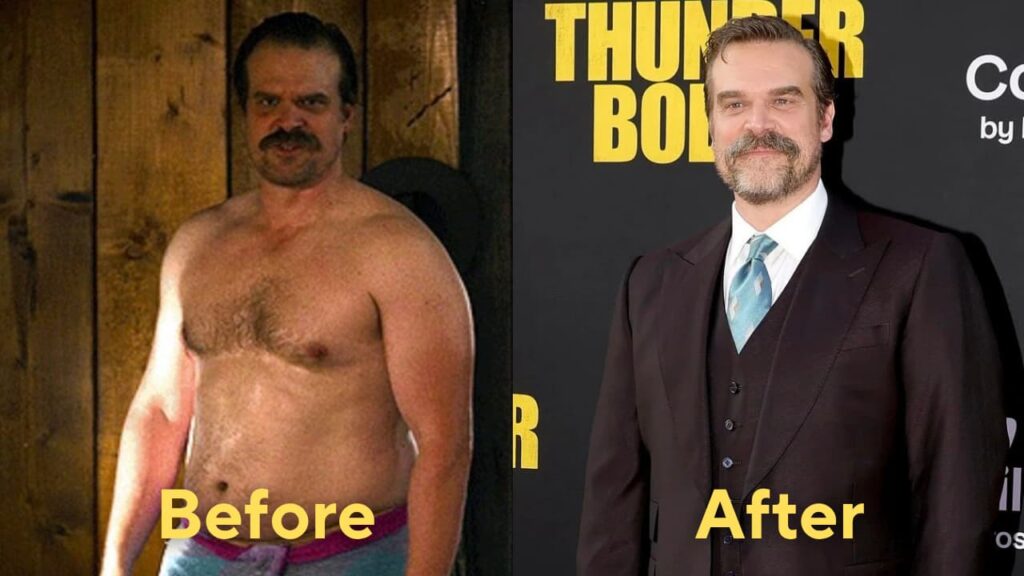
When Stranger Things Season 4 arrived and audiences saw Jim Hopper in a Russian prison camp, the physical transformation of David Harbour was immediately apparent. The Hopper that fans had known through the first three seasons was gone, replaced by someone visibly leaner, more angular, and carrying the physical wear of a man who had been through something brutal. It was one of the most striking actor transformations in recent television history, and it was entirely real.
Harbour lost approximately 75 to 80 pounds to prepare for the role, dropping from around 265 to 270 pounds down to approximately 190 pounds. The process took around six to seven months, followed by a further year of maintaining the lower weight due to production delays. He has since been candid about how demanding it was and why he has no intention of doing it again.
The Full Transformation at a Glance
| Category | Detail |
| Total weight lost | ~75–80 lbs (34–36 kg) |
| Starting weight | ~265–270 lbs (120–122 kg) |
| Final weight | ~190 lbs (86 kg) |
| Initial loss timeline | ~45–50 lbs in first 3 months |
| Full timeline | ~6–7 months + ~1 year maintenance |
| Primary diet method | Intermittent fasting + calorie deficit |
| Exercise | Long-distance running, Pilates, strength training |
| Reason | Role of Jim Hopper in Stranger Things Season 4 |
Why He Did It: The Role Demanded It
The transformation was not a personal wellness project. It was a job requirement. Hopper in Season 4 is a prisoner in a Russian labour camp, physically diminished and surviving in harsh conditions. That storyline required Harbour to look the part in a way that makeup and costume alone could not achieve.
He committed to the transformation knowing it would be one of the most physically demanding things he had attempted for a role, and the result is visible in every scene he appears in during that season. The lean, worn appearance he brought to the character was the direct product of months of disciplined dietary and exercise work.
The Diet: Calorie Control and Intermittent Fasting
Harbour has been straightforward in interviews about what actually drove the weight loss: a consistent calorie deficit, sustained over time. His own phrasing was simple calories in, calories out which cuts through the noise of most celebrity transformation coverage to describe something medically accurate.
The primary dietary tool was intermittent fasting. He ate within roughly six-hour windows each day, and incorporated occasional 24-hour fasts twice per week. The restricted eating windows naturally reduced his overall calorie intake without requiring him to track every meal obsessively.
Beyond the fasting structure, he shifted the quality of what he ate: more vegetables, significantly less sugar, and a general reduction in the high-calorie foods that had previously been part of his diet. There was no dramatic fad approach here, just structured calorie restriction applied consistently over many months.
The Training: Running, Pilates, and Weights
The exercise programme combined three distinct elements in a way that supported fat loss without sacrificing the muscle needed to look physically capable on screen.
Cardio was the foundation. Long, low-intensity running sessions lasting 60 to 90 minutes became a regular part of his routine, burning substantial calories while being sustainable over the extended timeline the transformation required.
Pilates played a particularly interesting role. The goal was not bulk, it was the lean, sinewy look of someone who has been doing hard physical labour without enough food. Pilates, which builds functional strength and body control without adding mass, contributed directly to that specific aesthetic.
Strength training rounded out the approach, helping maintain muscle mass during the significant weight loss period. Losing 75 to 80 pounds without preserving muscle typically produces a depleted rather than athletic appearance, and the combination of resistance work with the cardio helped manage that balance.
The Honest Part: How Hard It Was
Harbour has not romanticised the process. He described the transformation as difficult and exciting, and acknowledged that weight loss became progressively harder as his body adapted and resisted further change. He has talked about the fine line between pushing hard and pushing too far, which reflects the reality of extreme body composition changes rather than the sanitised version that tends to appear in fitness coverage.
After Season 4, he regained weight for subsequent roles including Violent Night and then faced the task of losing it again, which he found even more difficult the second time. The yo-yo pattern that many actors experience through role-based transformations is something he has spoken about with notable honesty. He has been clear that he does not plan to pursue another transformation at this scale.
Conclusion
David Harbour’s weight loss for Stranger Things Season 4 was real, substantial, and achieved through methods that are medically sound if demanding: a sustained calorie deficit, intermittent fasting, long cardio sessions, Pilates, and strength training over more than half a year. There was no shortcut and no magic approach, just consistent work applied to a clear goal.
It produced one of the most effective physical transformations in recent television, and his honesty about how hard it was and why he would not repeat it makes the story more useful than most celebrity fitness coverage tends to be.
Discover Also Has Carrie Underwood Had Plastic Surgery? The Full Verified Picture

M Adnan Akram is the founder and lead writer at Back Casting Room, where he covers celebrity biographies, family histories, and the lesser-known figures behind well-known names. His work focuses on separating verified public information from speculation, drawing on publicly available records, interviews, and credible reporting to build accurate, well-researched profiles.
With a particular interest in entertainment and pop culture, Adnan writes about everything from celebrity net worth breakdowns to the private individuals connected to famous names, the spouses, family members, and background figures whose stories rarely get told in full.
At Back Casting Room, the goal is straightforward: give readers accurate, well-sourced information without the clickbait or unverified claims that often surround celebrity-adjacent stories.