
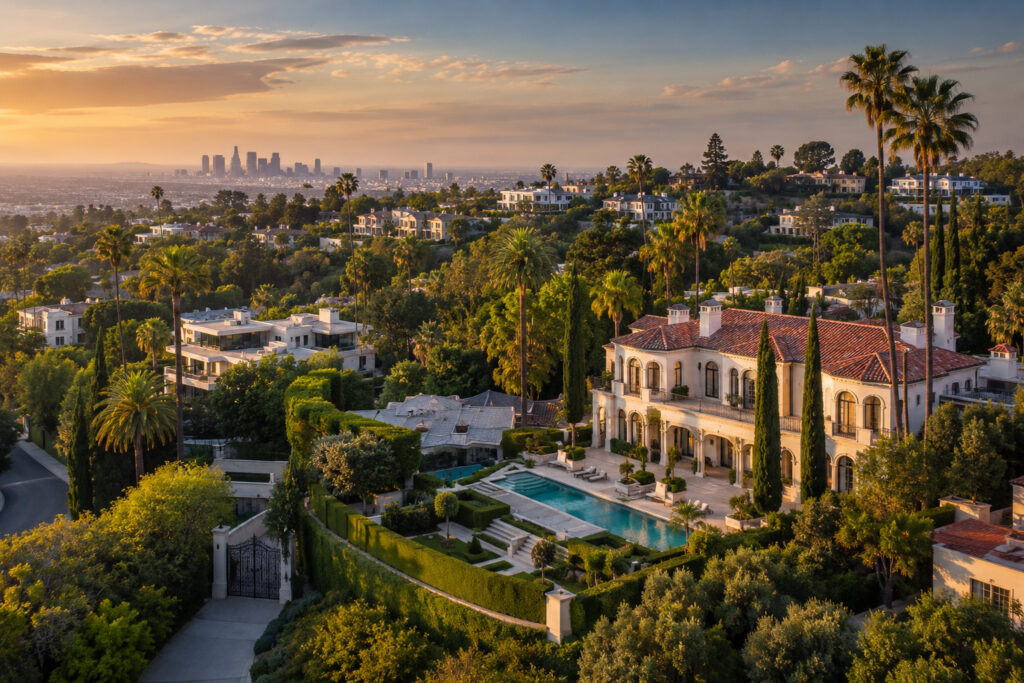
Beverly Hills and celebrity homes are so synonymous that the connection feels almost automatic. Mention the 90210 zip code and the mind immediately fills with gated driveways, manicured hedges, and the kind of architecture that only makes sense when money stops being a constraint. But the reality of celebrity houses in Beverly Hills is more nuanced and more interesting than the general impression suggests different neighborhoods attract different kinds of famous residents, the estates themselves have distinct histories and personalities, and the culture surrounding them has evolved dramatically over a century.
The Neighborhoods That Actually Matter
When people say “Beverly Hills,” they usually mean a general area rather than a specific neighborhood. But within and immediately around that famous zip code, there are a few distinct pockets where celebrity concentration runs particularly high.
The Flats
South of Sunset Boulevard, the Flats is the grid-like section of Beverly Hills characterized by wide, tree-lined streets and sprawling lots. The terrain is level, which means properties can spread horizontally in a way the hillside neighborhoods don’t allow. Stars who prefer the feel of a genuine compound, lots of usable outdoor space, large flat lawns, room for extensive guest houses and support structures gravitate here. The visibility is higher than in the hills, but the lot sizes justify the tradeoff.
Trousdale Estates
For architecture enthusiasts, Trousdale Estates is the crown jewel. Developed in the 1950s and 1960s on the highest ridges of Beverly Hills, the neighborhood has strict single-story height limits designed to protect the panoramic views of the Los Angeles basin below. That constraint produced some of the most celebrated Mid-Century Modern architecture in California: clean horizontal lines, floor-to-ceiling glass walls, seamless connections between interior and exterior living.
The history is extraordinary. Elvis Presley, Frank Sinatra, and their Rat Pack circle made Trousdale their home during the height of their fame. More recently, Jennifer Aniston and Ringo Starr have been associated with the neighborhood. The architecture attracts buyers who want a specific aesthetic, and the strict height limits have preserved that character through decades of real estate development pressure.
Beverly Park
Beverly Park sits above Beverly Hills proper technically in Beverly Crest and represents a different category of exclusivity entirely. It’s a triple-gated community with private security guards patrolling the streets around the clock. The properties here are among the largest in Southern California, and the security infrastructure is designed for buyers who require absolute privacy and protection as a non-negotiable.
Famous Estates Worth Knowing
Several properties in and around Beverly Hills have become landmarks in their own right, either because of their architecture, their history, or the celebrities who own them.
Jennifer Lopez and the 38,000-Square-Foot Compound
Following the public real estate drama involving her and Ben Affleck, Jennifer Lopez now holds full ownership of a compound that represents the Beverly Hills aesthetic taken to its logical extreme. At 38,000 square feet, the property includes 12 bedrooms, 24 bathrooms, a 12-car garage, and a 5,000-square-foot sports complex with a private pickleball court and professional gym. It’s less a house than a self-contained resort that happens to be someone’s primary residence.
Taylor Swift and the Samuel Goldwyn Estate
Taylor Swift’s Beverly Hills property is a different kind of story, one about historical preservation as much as luxury. The estate was originally built in 1934 for Samuel Goldwyn, the filmmaking mogul, as a Georgian Revival mansion. Swift didn’t just purchase it; she meticulously restored it to its original glory and successfully petitioned the city of Beverly Hills to designate it as an official historic landmark. That designation ensures the architecture will be protected indefinitely, regardless of future ownership. In a city that doesn’t always prioritize preservation over development, it’s a meaningful legacy decision.
The Richard Landry Manor: From Mark Wahlberg to Paris Hilton
Originally built and heavily customized by Mark Wahlberg, this mega-mansion in North Beverly Park sold to Paris Hilton and her husband Carter Reum for over $63 million. Designed by architect Richard Landry, the estate includes a private golf course, a custom skate park, a state-of-the-art home theater, and a resort-style pool complex. The price tag reflects the combination of the original construction quality and the Beverly Park location.
Sir Rod Stewart’s European Chateau
Rod Stewart’s Beverly Park estate is visually unlike anything else in the neighborhood, a 28,000-square-foot yellow chateau with a distinctly European aesthetic, also designed by Richard Landry. Nine bedrooms, grand wood-paneled library, ornate marble floors, and a feature that is uniquely Rod Stewart: a full-sized football pitch where he practiced regularly. The estate is an expression of personality in a neighborhood where most ultra-luxury properties trend toward similar contemporary aesthetics.
What These Homes Actually Include
To justify price tags ranging from $20 million at the lower end to well over $100 million for the most significant estates, Beverly Hills properties compete on a specific set of luxury amenities that have become nearly standard at this level.
Privacy and security are the baseline requirements. Biometric gates, hidden panic rooms, and landscaping grown to 20 feet or higher to block sightlines from the street or from tour buses are common throughout the hills. This isn’t paranoia; it’s the practical reality of living somewhere that has been a tourist attraction for a century.
Wellness and sports facilities have evolved significantly. Cold-plunge pools, infrared saunas, and commercial-grade gyms are expected. The specific sport courts have shifted, pickleball has largely replaced traditional tennis as the custom court of choice, reflecting the broader cultural shift happening at every price point.
Entertainment infrastructure reaches professional quality at this level. Screening rooms with commercial theater acoustics, underground wine cellars with dedicated tasting rooms, and infinity pools engineered to appear continuous with the canyon or city view beyond the property line are features that justify the premium over comparable square footage elsewhere.
A Century of Fascination
The public’s interest in celebrity houses in Beverly Hills isn’t a recent phenomenon. It dates to the 1920s, when movie studios actually produced and printed their own “Star Maps” guides to the homes of silent film legends as deliberate tools for building the mythological scale of Hollywood. Mary Pickford and Douglas Fairbanks lived at Pickfair, an estate that became the first great celebrity home story.
For decades, entrepreneurs sold printed maps on Sunset Boulevard corners to tourists wanting to drive past the gates of stars like Lucille Ball, Marilyn Monroe, and Jimmy Stewart. The maps were a cottage industry built around curiosity that the studios had originally seeded.
The modern version looks completely different. High perimeter hedges, gated entries, biometric security, and strict anti-stalking laws mean that physical star maps are mostly historical souvenirs. Current celebrity locations are tightly held secrets until properties hit the market through high-end real estate listings at which point the photography, floor plans, and history that were carefully protected for years become publicly available.
Conclusion
Celebrity houses in Beverly Hills tell multiple stories at once: about architectural ambition, about wealth at its most concentrated, about the specific pleasures that attract ultra-high-net-worth buyers to this particular patch of Southern California, and about a cultural fascination with fame and glamour that has been running continuously for over a century.
The neighborhoods have distinct characters, the estates have genuine histories, and the amenities reflect what luxury actually looks like when budget stops being the constraint. Understanding the layers behind the famous hedgerows makes the whole phenomenon more interesting than it is from the outside.
Discover Also Hailey Bieber Ring: Everything You Need to Know About Her Stunning Engagement Collection

M Adnan Akram is the founder and lead writer at Back Casting Room, where he covers celebrity biographies, family histories, and the lesser-known figures behind well-known names. His work focuses on separating verified public information from speculation, drawing on publicly available records, interviews, and credible reporting to build accurate, well-researched profiles.
With a particular interest in entertainment and pop culture, Adnan writes about everything from celebrity net worth breakdowns to the private individuals connected to famous names, the spouses, family members, and background figures whose stories rarely get told in full.
At Back Casting Room, the goal is straightforward: give readers accurate, well-sourced information without the clickbait or unverified claims that often surround celebrity-adjacent stories.