
If you’ve noticed that oval-cut diamonds and yellow gold bands have been everywhere in bridal jewelry for the past few years, Hailey Bieber is a significant reason why. Her engagement rings there are now effectively three in rotation have each sparked their own wave of imitation and influenced what brides are requesting from jewelers globally. The story behind each ring is genuinely fascinating, and the way she wears them together is as much a style statement as any individual piece.
The Original 2018 Ring: Minimalist and Iconic
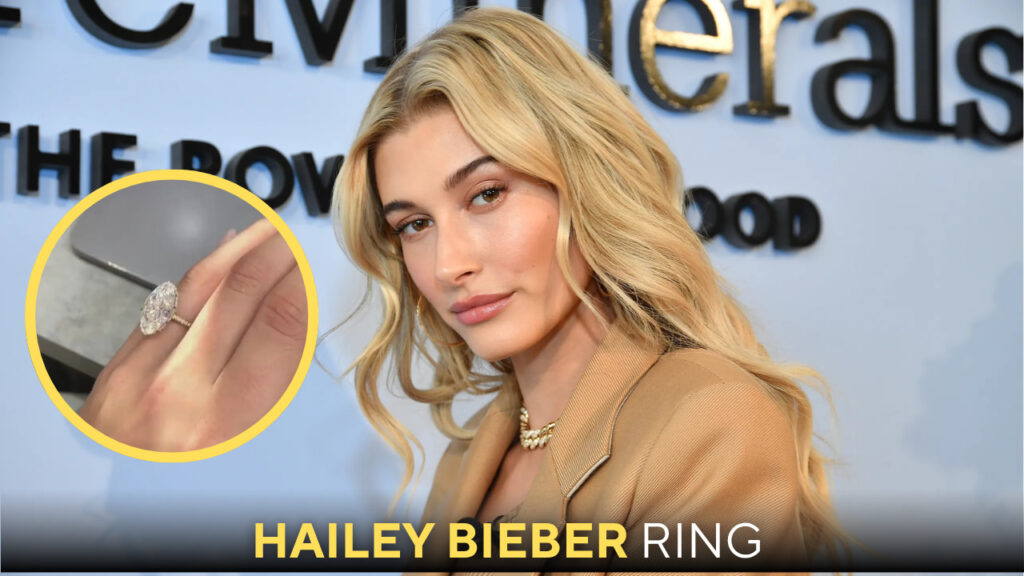
When Justin Bieber proposed in the Bahamas in July 2018, the ring he chose was a study in elegant restraint. Justin worked closely with Jack Solow of Solow & Co. in New York and reportedly took the process seriously, even using a jeweler’s loupe to personally inspect the diamond’s clarity before committing.
The result was a 6 to 10-carat oval-cut diamond set on a simple 18-karat yellow gold solitaire band. The oval shape was deliberately chosen for its elongated proportions, which complement the hand’s natural lines in a way that rounder cuts don’t always achieve.
One subtle detail that became widely discussed once it was noticed: the ring includes a hidden diamond halo tucked beneath the center stone’s basket invisible from above, but adding structural depth and catching light from below. The understated approach to the halo was intentional. It adds dimension without pulling attention from the main diamond.
Estimated value: around $500,000.
This ring essentially reignited the mainstream appetite for oval-cut stones and yellow gold settings, a combination that had felt slightly dated before Hailey made it feel modern and aspirational again.
The 2024 Upgrade: Enter the Moval
In May 2024, the Biebers renewed their vows in Hawaii and announced their first pregnancy and Justin marked the moment with a new ring from legendary jeweler Lorraine Schwartz, whose client list includes Beyoncé and Kim Kardashian.
When photos of the new ring circulated, the immediate response was that it looked dramatically larger than the original; some estimates pegged it at 18 carats. Hailey clarified in a W Magazine interview that the reality is more interesting than the speculation: the new diamond is actually only about 1 carat larger than the original.
The reason it looks almost double the size comes down to its cut. The stone is what the jewelry industry calls a “Moval” a cross between a marquise and an oval, with an exceptionally elongated length-to-width ratio. That silhouette covers more surface area on the finger than a conventional oval of the same carat weight. The visual effect is significant: a stone that might be 7 to 11 carats appears dramatically larger because of how it lies across the hand.
The setting is similarly considered. A slightly thicker 3mm yellow gold band provides the structural stability a heavy stone needs, and the prongs use a modern NSEW (North, South, East, West) compass-style claw configuration, a contemporary design choice that lets more light reach the stone from the sides.
Estimated value: $1 million to $1.5 million.
How She Wears Both Rings at Once
The decision not to retire her original ring is one of the more quietly influential styling moves in celebrity jewelry. Rather than storing it away, Hailey created a new role for it.
Left hand: The Lorraine Schwartz Moval occupies the ring finger, typically stacked with a Tiffany & Co. pavé diamond V-shaped wishbone band and matching platinum eternity bands from the vow renewal.
Right hand: The original Solow & Co. oval moved to her right pinky finger. It’s almost certainly the most valuable pinky ring in Hollywood and the move turned what could have been a sentimental keepsake into an active daily accessory.
That stacking approach wearing both rings simultaneously on different hands has since been widely copied and discussed in bridal styling conversations globally.
The 2025 East-West Addition
Adding another dimension to the collection, Hailey was spotted in early 2025 wearing a third significant ring: an ultra-elongated cushion-cut diamond estimated at 10 to 12 carats, set East-to-West horizontally across the finger rather than vertically on a yellow gold solitaire band.
The East-West setting is a deliberate departure from convention. Traditionally, diamonds are mounted with their length running up the finger. Rotating the stone 90 degrees creates a lower, wider profile that lies closer to the hand and reads as distinctly modern. The trend has since shown up in bridal inquiries at jewelry studios that follow what Hailey wears.
Why This Collection Actually Matters to the Jewelry Industry
Jewelers have been paying attention. The cumulative effect of Hailey’s rings, the original oval, the Moval upgrade, the East-West cushion has measurably influenced what brides are requesting.
Yellow gold bands with colorless diamonds experienced a meaningful resurgence directly tied to her choices. The demand for elongated oval and Moval cuts from brides wanting the same “looks larger than it is” effect has translated into real production shifts at diamond cutters. East-West settings have moved from niche design choice to mainstream request.
Conclusion
Hailey Bieber’s ring collection is an unusually coherent story about how individual jewelry choices can shape industry trends at scale. Each ring has its own character: the minimalist original, the optically dramatic Moval, the horizontally-set cushion and together they demonstrate a consistent design philosophy: elongation, yellow gold, and settings that prioritize the visual experience of the stone over technical convention.
If you’re planning a ring purchase and looking for direction, there’s a reason the oval and Moval are dominating the options at every price point right now. The influence isn’t coincidental.
Discover Also Marquise Diamond Selena Gomez: The Story Behind the Stone That Stopped the Internet

M Adnan Akram is the founder and lead writer at Back Casting Room, where he covers celebrity biographies, family histories, and the lesser-known figures behind well-known names. His work focuses on separating verified public information from speculation, drawing on publicly available records, interviews, and credible reporting to build accurate, well-researched profiles.
With a particular interest in entertainment and pop culture, Adnan writes about everything from celebrity net worth breakdowns to the private individuals connected to famous names, the spouses, family members, and background figures whose stories rarely get told in full.
At Back Casting Room, the goal is straightforward: give readers accurate, well-sourced information without the clickbait or unverified claims that often surround celebrity-adjacent stories.