
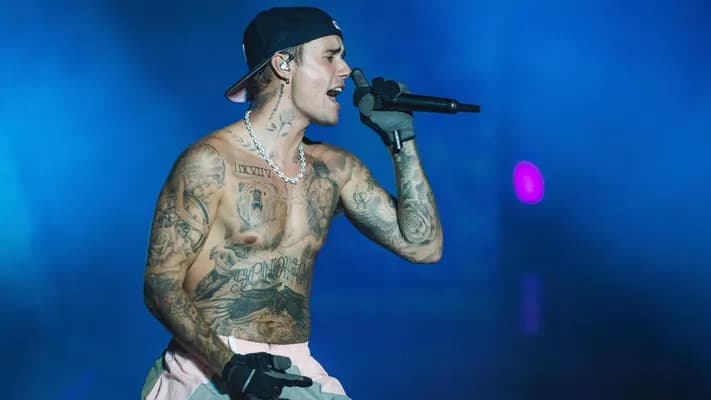
Under the desert lights of the Coachella Valley Music and Arts Festival, Justin Bieber returned to one of music’s most visible stages with a headline performance that felt both expansive and deeply personal. It was not just a set built on familiarity, but one that moved deliberately between past and present, offering a portrait of an artist who has spent much of his life evolving in public.
Taking the stage during the festival’s opening weekend in April 2026, Bieber delivered a performance that drew from across his catalog. Early hits like “Baby” and “Beauty and a Beat” resurfaced alongside newer material, creating a setlist that traced the arc of his career rather than focusing on any single era. The pacing was unhurried at times, even unconventional, with moments where he stepped away from traditional stage dynamics and leaned into a more relaxed, almost improvised flow.
What gave the performance its shape, however, was the steady arrival of collaborators. Artists including The Kid LAROI, Wizkid, Tems, Dijon, and Mk.gee joined him on stage, each adding a different texture to the night. These appearances were not treated as spectacle alone; instead, they felt integrated into the set’s rhythm, reinforcing the collaborative thread that has defined much of Bieber’s recent work.
Away from the music, the tone shifted subtly toward something more intimate. Bieber acknowledged his wife, Hailey, who was present in the audience, and made a brief but noticeable reference to their son. These moments, while simple, grounded the performance in a way that large festival sets rarely achieve, offering a glimpse of the person behind the global image.
The response to the show has been varied but engaged. Some praised the willingness to break from tightly scripted performances, while others questioned elements of its structure. Yet even within that divide, there was a shared sense that the set stood apart from the festival’s more conventional headline moments.
Coachella has long been a place where careers are reaffirmed or redefined, and for Bieber, this appearance seemed to do a bit of both. It revisited the scale of his global success while also suggesting a quieter, more reflective phase of his artistry. In that balance, the performance found its identity not just as a headline slot, but as a moment that lingered beyond the final note.
Discover Also P-Pop Group BINI Makes History with Coachella Debut

M Adnan Akram is the founder and lead writer at Back Casting Room, where he covers celebrity biographies, family histories, and the lesser-known figures behind well-known names. His work focuses on separating verified public information from speculation, drawing on publicly available records, interviews, and credible reporting to build accurate, well-researched profiles.
With a particular interest in entertainment and pop culture, Adnan writes about everything from celebrity net worth breakdowns to the private individuals connected to famous names, the spouses, family members, and background figures whose stories rarely get told in full.
At Back Casting Room, the goal is straightforward: give readers accurate, well-sourced information without the clickbait or unverified claims that often surround celebrity-adjacent stories.