
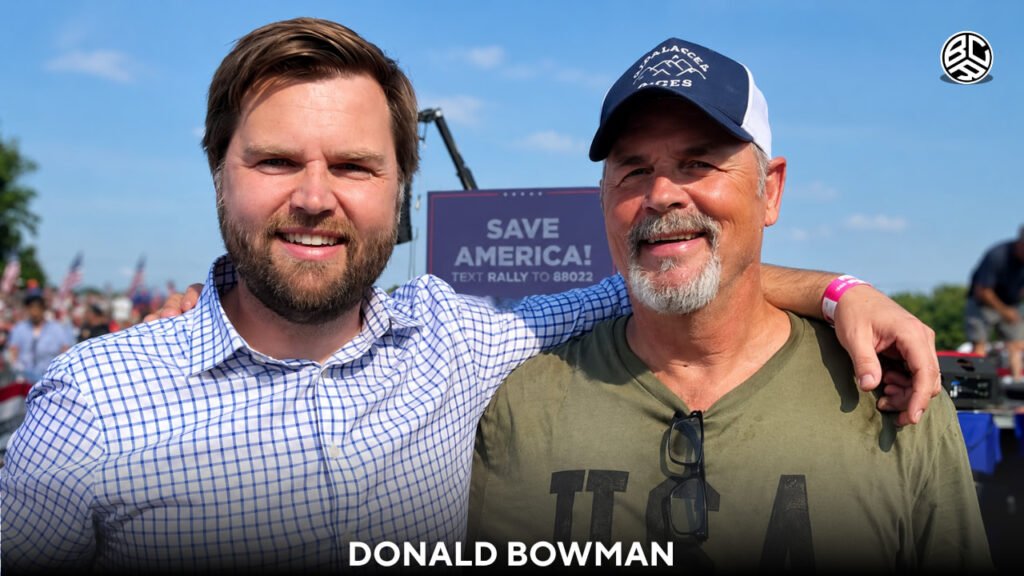
There is a particular kind of public figure who becomes known not through anything they did, but through what someone else wrote about them. Donald Ray Bowman is that kind of figure.
He has never held public office. He has never given a major interview. He has no documented public career and no social media presence to speak of. And yet, because his son grew up to become the Vice President of the United States, his name has entered the broader American conversation attached to one of the most influential memoirs of the past decade and to a political identity shaped, in large part, by his early departure from his son’s life.
Understanding Donald Bowman means understanding absence as a biographical fact and recognizing how much a person’s choice to disappear can define the person left behind.
Quick Summary
| Field | Details |
|---|---|
| Full Name | Donald Ray Bowman |
| Known For | Biological father of U.S. Vice President JD Vance |
| Nationality | American |
| Former Partner | Beverly Aikins (later Beverly Vance) |
| Children | James David “JD” Vance, Cory Bowman |
| Notable Relative | JD Vance (son, U.S. Vice President) |
| Public Status | Private citizen |
| Notable For | Referenced in Hillbilly Elegy as JD Vance’s biological father and for consenting to JD Vance’s adoption by Bob Hamel during childhood. |
The Relationship with Beverly Vance
In the early 1980s, Donald Bowman was in a relationship with Beverly Vance, a woman who would later become known publicly through her son’s memoir as a central, complicated figure in his childhood. Beverly and Donald’s relationship produced one child together: a boy born on August 2, 1984, in Middletown, Ohio.
They named him James Donald Bowman. The middle name was chosen in honor of his father.
The relationship did not last. By the time their son was still a toddler, Donald Bowman had separated from Beverly, and what followed was a departure that would echo through years of his son’s life and eventually through the pages of Hillbilly Elegy.
A Childhood Shaped by an Empty Chair
JD Vance, the name the world now knows, wrote candidly in his memoir about what it felt like to learn, as a young child, that his biological father no longer wanted to be part of his life. He described it as one of the most painful moments of his childhood. The kind of moment that does not fully resolve itself, that leaves a particular shape in a person’s understanding of what stability means and where it can be found.
What followed was a childhood defined by change. Multiple stepfathers entered and exited his life. His mother struggled with addiction. The grandparents he called Mamaw and Papaw became the most consistent parental figures he had. The absence of a biological father was not just an emotional wound, it was a structural reality that reorganized everything around it.
Donald Bowman’s departure was not the only force shaping those years. But it was the first.
The Adoption and the Name Changes
When JD Vance was around six years old, Donald Bowman reportedly consented to his son’s adoption by Beverly’s later husband, Bob Hamel. It was a legal relinquishment, a formal acknowledgment that another man would take on the role he had stepped away from.
The adoption triggered a sequence of name changes that became, in retrospect, a kind of biographical shorthand for his son’s unstable early years.
James Donald Bowman became James David Hamel. The middle name Donald was removed, replaced with David to preserve the initials J.D. Years later, in 2013, Vance would take his maternal grandparents’ surname becoming James David Vance, and eventually JD Vance as a deliberate act of honoring the people who had actually raised him.
The name he was given at birth, in honor of his father, did not survive into adulthood.
A Brief Return, and What It Meant
Reports indicate that Donald Bowman did briefly re-enter his son’s life during JD Vance’s teenage years. The reconnection did not appear to reshape their relationship in any lasting or significant way. By then, the formative years had already passed, and the figures who had filled the parental role of his grandparents above all were the ones Vance would consistently credit throughout his public life.
It is not unusual for estranged parents to attempt reconnection once children reach adolescence. What matters in Vance’s telling is not that the door was closed, but that the relationship never became central to who he was. The grandfather figure, the Mamaw who raised him, the Marine Corps these were the institutions and people that shaped him. His biological father remained, in his own account, a peripheral presence.
Cory Bowman: The Half-Brother Who Kept the Name
Donald Bowman went on to have another son Cory Bowman, who is JD Vance’s half-brother. Unlike Vance, Cory kept the Bowman surname. He became an evangelical pastor and coffee shop owner in Cincinnati, and in 2025 he ran in the Cincinnati mayoral primary surviving the primary to reach the general election.
The two brothers were largely estranged during childhood, a natural consequence of their different circumstances and households. They developed a relationship later in life, as adults, though the details of how close they remain are not part of the public record.
Cory Bowman’s public life offers an interesting parallel: a son who kept his father’s name, who entered public life through faith and local politics rather than national office, and who grew up in a very different context than the half-brother who would eventually stand at one of the most prominent addresses in American government.
What Cannot Be Confirmed
Donald Bowman is a private citizen, and that status means the public record about him is genuinely thin. His birth date, birthplace, education, occupation, and current residence are not publicly documented. His marital history beyond his relationship with Beverly Vance is not confirmed. He has made no known public statements about his son’s career or memoir.
Much of what appears online about him comes from secondary biographical sites rather than original reporting, and should be treated with appropriate skepticism.
The Weight of Absence
What makes Donald Bowman’s story notable in the context of American public life is not who he is, but what his absence produced. Hillbilly Elegy became one of the most discussed books about class, family, and the American dream of the past twenty years. Its central themes: the instability of working-class families, the search for father figures, the long shadow of addiction and departure are all, in part, traceable back to the early years of a childhood without a biological father.
JD Vance has never defined his identity by bitterness toward his father. His memoir is more complex than that. But the shape Donald Bowman’s absence left is visible throughout in the chapters about yearning for stability, in the admiration for men who showed up consistently, in the choice to name a son something other than Donald.
Conclusion
Donald Bowman is, by every measure, a private man who has stayed private. He has not sought to comment on his son’s rise, has not inserted himself into the political narrative, and has not offered his own account of the years that shaped JD Vance’s most personal story.
What the public record preserves is the outline: a relationship that ended early, a name passed on and then quietly discarded, and a son who built a life and eventually a career around the values he found in the people who stayed.
Sometimes the most consequential thing a person does is leave.
Discover Also Shannon Carpenter (Carpenter Shannon): Sabrina’s Sister, the Dancer Who Chose Her Own Path

M Adnan Akram is the founder and lead writer at Back Casting Room, where he covers celebrity biographies, family histories, and the lesser-known figures behind well-known names. His work focuses on separating verified public information from speculation, drawing on publicly available records, interviews, and credible reporting to build accurate, well-researched profiles.
With a particular interest in entertainment and pop culture, Adnan writes about everything from celebrity net worth breakdowns to the private individuals connected to famous names, the spouses, family members, and background figures whose stories rarely get told in full.
At Back Casting Room, the goal is straightforward: give readers accurate, well-sourced information without the clickbait or unverified claims that often surround celebrity-adjacent stories.