
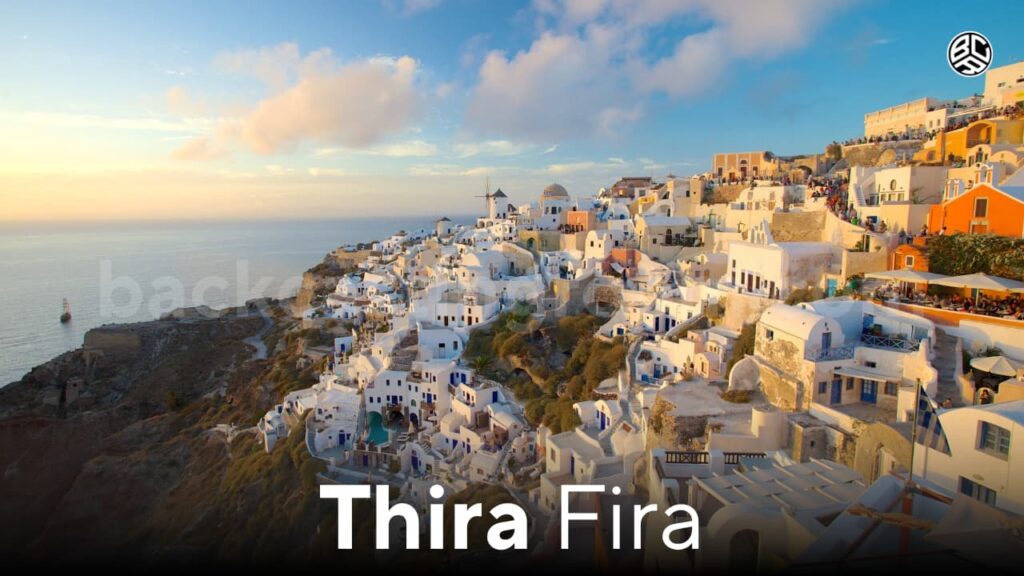
There is a moment usually somewhere between stepping off the cable car and catching your first unobstructed view of the caldera when Thira Fira stops being just a place on a map and becomes something you feel in your chest. Whitewashed walls, blue-domed churches, the endless Aegean stretching out below you, and a 400-metre volcanic cliff dropping straight into one of the most dramatic seascapes on earth.
The capital of Santorini goes by a few names. Locals and Greeks call it Fira (Greek: Fira Thiras). Older maps and historical references use Thira or Thera. International travellers often search for it by both. Whatever name you arrive with, what you find is the same: the beating heart of one of the world’s most photographed islands, a town built on the rim of an ancient volcano and shaped by centuries of history, earthquakes, and an extraordinary relationship with the sea.
This guide covers everything worth knowing before you arrive.
The Name and What It Means
The word Fira is simply an alternative Greek pronunciation of Thira, which is the ancient name for the island itself. The full official name, Fira Thiras, means roughly ‘Fira of Thera,’ reflecting both the town and the island it serves as capital. So when travellers search for Thira Fira, they are pointing at exactly the right place: the main town of Santorini, sitting on the western edge of the island along the caldera’s rim.
The island’s name Thera has ancient roots. According to Herodotus, the Phoenicians originally called it Kallisti meaning ‘the most beautiful’ a name that is hard to argue with even today. The name Thera came later, attributed to the Spartan Thiras, who settled the island with a group of aristocrats long before it became the Aegean jewel it is now.
Built on Volcanic Fire
To understand Fira, you have to understand what it is sitting on top of. Santorini is not just a scenic island, it is the result of one of the most catastrophic volcanic events in recorded human history.
Around 3,600 years ago, a massive Minoan eruption tore through the island, hurling ash tens of kilometres into the atmosphere, triggering tsunamis across the eastern Mediterranean, and causing the central mass of the island to collapse into the sea. What remained was a crescent-shaped ring of land surrounding a deep, flooded caldera. The cliffs you see from the western edge of the capital are the interior walls of that ancient crater, sheer, layered, and geologically extraordinary.
Volcanologists note that Santorini has undergone twelve powerful eruptions over the past 350,000 years. The caldera stretches roughly 8 by 11 kilometres, and at the centre you can still see Nea Kameni, an active volcanic island that formed from more recent eruptions and continues to grow slowly. The sense of standing on living geology here is not just metaphor. It is a fact.
The Town Itself What to Expect
Fira is the largest settlement on Santorini and has been the island’s administrative capital since the 18th century, when the old capital at Skaros in Imerovigli was abandoned after a series of damaging earthquakes. Today it is a dense, vibrant, walkable town spread along the caldera’s edge, with its main streets running parallel to the cliff.
The Layout
The town has two distinct levels. Up top at caldera rim height you find the main streets, shops, restaurants, bars, and churches. Down below, at sea level, lies Gialos, the old port where cruise ships anchor. Connecting them is a 600-step stone path zigzagging down the cliff face, a cable car that makes the journey in minutes, and the famous donkey rides that have been carrying passengers up and down for generations.
The central square, Plateia Theotokopoulou, serves as the practical hub of town. From here you can catch buses to every corner of the island, find banks and pharmacies, and get your bearings before heading in any direction.
The Caldera View
The panoramic view from the town’s western edge is what places Fira among the most visited spots in the entire Aegean. On a clear day, you can see the full 18-kilometre arc of the caldera from Cape Akrotiri in the south to Cape Ag. Nikolaos in the north. Thirassia Island sits opposite, and Nea Kameni smolders quietly at the centre. Large cruise ships anchored in the bay below look almost toy-like against the scale of the landscape.
Landmarks and Things to See
Churches Worth Visiting
The Orthodox Cathedral is the town’s largest church, rebuilt after the catastrophic 1956 earthquake that destroyed much of Santorini. Inside, it contains striking frescoes; outside, mosaics cover the facade. There is also a Baroque Catholic cathedral from the early 1800s dedicated to St John the Baptist, and a Dominican Convent where the sound of nuns singing in the evenings drifts into the street in a way that feels completely out of time.
The most photographed religious structure in town is the Three Bells of Fira, a Catholic church known for its elegant trio of arched bells and the classic blue-domed roof that has become shorthand for Santorini in travel photography the world over.
Museums
The capital holds two of the island’s most important museums. The Archaeological Museum of Thera sits close to the cable car entrance and houses artefacts spanning from the Archaic period through to Roman times. The Museum of Prehistoric Thera focuses on the Bronze Age civilisation destroyed by the Minoan eruption including remarkable finds from the buried city of Akrotiri. Both are compact, well-curated, and genuinely worthwhile.
For those interested in local life rather than ancient history, the Folklore Museum Lignos and the Megaro Gyzi cultural centre offer a different perspective on what it has meant to live on this island across the centuries.
Getting Around and Getting There
The Cable Car and the Steps
One of the most memorable parts of any visit to Fira is the descent to Gialos port. The cable car takes roughly three minutes and delivers you to the waterfront, where small taverns serve fresh fish and the scale of the caldera cliff above becomes genuinely awe-inspiring. If you prefer to walk, the 600 stone steps are well-maintained and offer excellent views, though they can be tiring in summer heat. The traditional donkey rides are still available for those who want to experience how people navigated this cliff for centuries.
Getting Around the Island
The central bus station connects to almost every village on Santorini, including Oia, Akrotiri, Kamari, and Perissa. Buses run frequently during tourist season and are reasonably priced. The island’s international airport is only about a 10-minute drive from the capital, making Fira an easy and practical base for exploring the whole island.
Neighbouring Villages Worth Exploring
Fira connects seamlessly to the neighbouring settlements of Firostefani and Imerovigli along the caldera rim. Firostefani is a quieter extension of the capital with equally spectacular views and a slightly more relaxed atmosphere walkable from the centre in about 10 minutes. Imerovigli, roughly 25 minutes on foot, sits at the highest point of the caldera and offers some of the most dramatic scenery on the island.
Oia, the famous village known for its sunset views, is less than a 30-minute drive north. Most visitors end up comparing the two, but they are different enough that the comparison misses the point. The capital offers nightlife, urban energy, and a full range of practical amenities. Oia offers quieter streets and slower evenings. Both reward your time.
Food, Shopping, and After Dark
The capital stays lively year-round, which sets it apart from many island towns that go quiet after summer. During the day, narrow streets fill with small shops selling handmade jewellery, ceramics, local wines, and the island’s signature products sundried tomatoes, fava beans, capers, and aromatic herbs grown in the volcanic soil. Santorini wine, made primarily from the Assyrtiko grape, is worth seeking out at local wine shops and vineyards.
After dark, the clifftop restaurants and caldera-view bars come into their own. The setting alone tables overlooking a volcanic crater filled with dark water, fairy lights strung across the lanes, the lights of Thirassia across the bay makes even a simple meal feel like something more. Clubs and music bars keep the town going well into the early hours during peak season.
Best Time to Visit
The island is busiest in July and August, when crowds at the caldera viewpoints can be substantial and accommodation prices peak. For a more comfortable experience with most facilities still open, late May, June, and September offer warm weather, calmer streets, and often better deals.
Spring visits in April and early May are ideal for those who want to explore without the summer intensity. Wildflowers bloom across the volcanic landscape, the light is extraordinary, and most of the main attractions are open. Even winter has its advocates: cooler, quiet, and giving you the rare experience of the island without crowds.
Conclusion
Fira, known historically as Thira and formally as Thira Fira, earns its reputation as one of the great travel destinations in the Mediterranean. It is not just about the photographs, though the caldera views genuinely live up to their billing. It is about the layers underneath: a volcanic geology that shaped everything here, an ancient history that left temples and artefacts buried in ash, and a modern town that has found a way to remain authentically Greek even under the weight of global tourism.
Whether you come for the sunsets, the history, the local food and wine, or simply the experience of standing on the rim of one of earth’s most dramatic landscapes, the capital of Santorini rewards every kind of traveller. Give it more than a day there is far more here than first appears.
Discover Also Hellas Santorini: The Island That Redefined Beauty in the Aegean

M Adnan Akram is the founder and lead writer at Back Casting Room, where he covers celebrity biographies, family histories, and the lesser-known figures behind well-known names. His work focuses on separating verified public information from speculation, drawing on publicly available records, interviews, and credible reporting to build accurate, well-researched profiles.
With a particular interest in entertainment and pop culture, Adnan writes about everything from celebrity net worth breakdowns to the private individuals connected to famous names, the spouses, family members, and background figures whose stories rarely get told in full.
At Back Casting Room, the goal is straightforward: give readers accurate, well-sourced information without the clickbait or unverified claims that often surround celebrity-adjacent stories.