

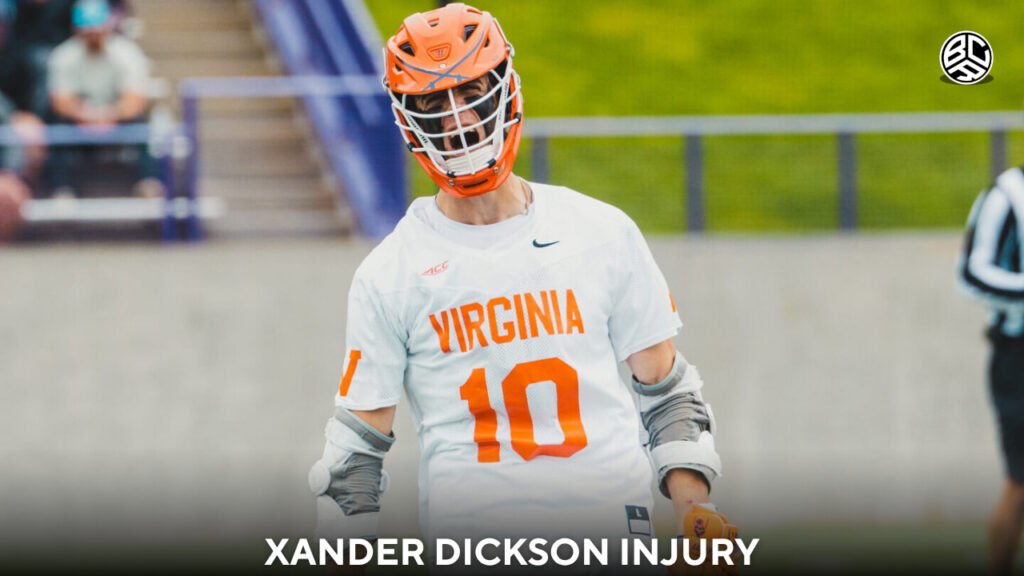
Championship games are supposed to be the best moments of an athlete’s career. For Xander Dickson, the 2025 Premier Lacrosse League Championship game became something far more complicated: a collision, a stretcher, a trip to the hospital, and the start of one of professional lacrosse’s most closely followed comeback stories.
Dickson, an attacking player for the New York Atlas, went down during the championship match against the Utah Archers after a collision that required immediate medical attention. He was taken off the field on a stretcher and transported to the hospital for evaluation. It was a moment that shocked everyone watching teammates, opponents and fans.
The Atlas won their first PLL championship that day. And their injured teammate watched part of the celebration before being taken away.
Who Is Xander Dickson?
Before understanding the weight of the injury, it helps to know who Xander Dickson is in the lacrosse world.
He played college lacrosse for the Virginia Cavaliers, where he established himself as one of college lacrosse’s most dangerous offensive players. After graduating, he joined the New York Atlas in the Premier Lacrosse League and became one of the team’s most important contributors, a skilled attacker known for his scoring ability and the kind of impact that shows up in winning margins.
Going into the 2025 PLL Championship, he was not a peripheral figure. He was one of Atlas’s key players. That context makes what happened during the game all the more significant.
What Happened During the Championship Game
The specific details of the collision and the exact nature of Dickson’s injury were not publicly released by the PLL or the Atlas organization. The diagnosis and the specific body part affected remain unconfirmed in the public record.
What is confirmed is what everyone saw: he went down, he needed immediate medical attention, he was carried off the field on a stretcher, and he was taken to the hospital.
In the chaos of a championship game, those images carried enormous weight. His teammates continued playing without him, but the emotional atmosphere of the game had shifted. When Atlas won, the celebration was inseparable from the concern for their injured player.
Reports from the time noted that Dickson was able to witness part of the championship celebration before being taken to the hospital, a detail that added a particular emotional texture to Atlas’s first PLL title. He was there for enough of it to know they had won.
The Comeback: 236 Days
The Premier Lacrosse League later documented Dickson’s rehabilitation process in a feature titled “Unfinished: Inside Xander Dickson’s 236 Day Comeback.” The title alone 236 days gives a sense of the scope of what he went through to return to professional competition.
236 days is roughly eight months. It is the kind of timeline that tests everything: physical conditioning, mental resilience, the patience required to rebuild when your body will not yet cooperate, and the discipline to show up for work every single day without the feedback of actual competition.
The PLL’s decision to document the journey in a feature reflects both the significance of the comeback and the broader appeal of athlete recovery stories, the part of sports that is less about winning and more about the person underneath the jersey.
What the Atlas Championship Win Meant
It is hard to separate the story of Xander Dickson’s injury from the story of Atlas winning their first PLL championship. The two are bound together in the way that sports moments sometimes are where something deeply unfortunate and something genuinely triumphant happen in the same afternoon, inseparable from each other.
His teammates have spoken about using the injury as motivation during the game. The emotional charge of watching a key player leave on a stretcher and the desire to win something he could be part of even from a hospital shaped how Atlas approached those final minutes.
Conclusion
Xander Dickson’s injury during the 2025 PLL Championship was one of professional lacrosse’s most emotional moments of the year. The specifics of the diagnosis were never made public, but the impact was visible to everyone watching and the 236-day comeback that followed became a story about what athletes endure when the game takes something from them unexpectedly.
He got back. That is the part that mattered most.
Discover Also Sophie Cruz: The Young Voice Behind a Global Immigration Movement

M Adnan Akram is the founder and lead writer at Back Casting Room, where he covers celebrity biographies, family histories, and the lesser-known figures behind well-known names. His work focuses on separating verified public information from speculation, drawing on publicly available records, interviews, and credible reporting to build accurate, well-researched profiles.
With a particular interest in entertainment and pop culture, Adnan writes about everything from celebrity net worth breakdowns to the private individuals connected to famous names, the spouses, family members, and background figures whose stories rarely get told in full.
At Back Casting Room, the goal is straightforward: give readers accurate, well-sourced information without the clickbait or unverified claims that often surround celebrity-adjacent stories.