
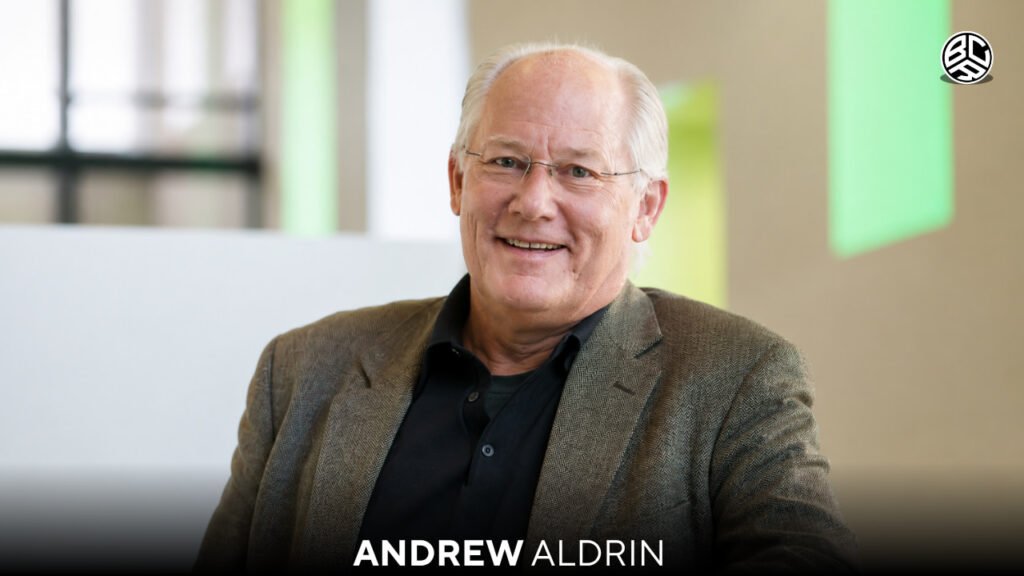
When people hear the last name “Aldrin,” most minds jump straight to the Moon landing and the iconic photograph of a boot print in lunar dust. But there’s another Aldrin quietly shaping the future of space exploration in a very different way through classrooms, boardrooms, and university programs rather than spacecraft cockpits. That’s Andrew Aldrin, and his story is less about walking on the Moon and more about making sure the next generation gets the chance to reach for it.
Andrew “Andy” Aldrin is an aerospace executive, educator, and space policy expert whose career spans commercial spaceflight companies, defense research institutions, and academic leadership. He also happens to be the youngest son of Buzz Aldrin, the Apollo 11 astronaut who became the second person to set foot on the Moon. Rather than living in his father’s shadow, Andrew has built a distinct legacy of his own, centered on education, entrepreneurship, and expanding humanity’s presence beyond Earth.
Quick Summary
| Category | Details |
|---|---|
| Full Name | Dr. Andrew “Andy” Aldrin |
| Known For | Aerospace executive, educator, and son of Apollo 11 astronaut Buzz Aldrin |
| Profession | Aerospace Executive, Space Policy Expert, Educator |
| Current Position | CEO & President, Aldrin Family Foundation |
| Academic Role | Executive Director for Space Programs, Embry-Riddle Aeronautical University Worldwide |
| Nationality | American |
| Education | Ph.D. (UCLA), Global Executive MBA (TRIUM), M.A. (George Washington University), B.A. (UC Santa Barbara) |
| Previous Roles | President of Moon Express; Director of the Buzz Aldrin Space Institute; Leadership roles at United Launch Alliance, Boeing, RAND Corporation, and the Institute for Defense Analyses |
| Primary Focus | Commercial space exploration, space policy, STEAM education, and space entrepreneurship |
| Public Figure Status | Public figure in the aerospace and education sectors (not a mainstream celebrity) |
| Family | Youngest son of Apollo 11 astronaut Buzz Aldrin and Joan Archer Aldrin |
| Residence | United States (publicly associated with Florida through his professional work) |
Who Is Andrew Aldrin?
At his core, Andrew Aldrin is someone who has spent decades translating big ideas about space into practical programs, policies, and business strategies. He currently serves as the CEO and President of the Aldrin Family Foundation, a nonprofit dedicated to inspiring students through science, technology, engineering, arts, and mathematics commonly known as STEAM education.
Alongside that role, he holds the position of Executive Director for Space Programs at Embry-Riddle Aeronautical University Worldwide, one of the most respected institutions in the country for aviation and aerospace studies. Between these two roles, his work touches everyone from elementary school students discovering their first interest in rockets to graduate researchers shaping the future of space policy.
A Foundation Built on Education
An aerospace career doesn’t usually start in a classroom, but for Andrew, education has always been part of the mission. Since joining the Aldrin Family Foundation in 2014, he has led initiatives that have reportedly reached more than 300 schools and universities. The goal isn’t just to teach kids about astronauts and rockets, it’s to build genuine enthusiasm for STEAM careers that will keep the space industry growing for decades to come.
Academic Background
Few people in the aerospace world have an academic résumé quite as layered as this one. His educational journey includes:
- A Ph.D. in Political Science from the University of California, Los Angeles (UCLA)
- A Global Executive MBA through the TRIUM Program, a joint offering from NYU Stern, the London School of Economics, and HEC Paris
- A Master’s degree in Science, Technology and Public Policy from George Washington University
- A Bachelor’s degree in International Relations from the University of California, Santa Barbara
That combination of political science, public policy, and business strategy explains a lot about his career path. Space exploration isn’t only about engineering, it’s also about funding, regulation, international cooperation, and public support. Understanding all of those moving parts requires exactly the kind of interdisciplinary background he built over the years.
A Career Spanning Commercial Space and Defense Policy
Long before stepping into education and nonprofit leadership, Andrew Aldrin held a series of senior roles across the aerospace sector, each one adding a new layer to his expertise.
Early Research Roles
He began building his policy chops at institutions known for rigorous analysis, including the RAND Corporation and the Institute for Defense Analyses. These organizations are known for shaping national security and technology strategy, and the experience gave him a grounded understanding of how government decisions ripple through the aerospace industry.
Leadership at Major Aerospace Companies
From there, his career moved into some of the biggest names in the industry. He held executive leadership positions at United Launch Alliance (ULA) and Boeing, two companies central to America’s satellite launch and defense capabilities. These roles placed him at the center of high-stakes decisions about launch vehicles, government contracts, and long-term space strategy.
Commercial Lunar Exploration
Perhaps one of the more entrepreneurial chapters of his career came with Moon Express, a private company focused on lunar exploration. Serving as President there put him at the forefront of the commercial space race, a period when private companies were beginning to seriously challenge the idea that only government agencies could reach the Moon.
Academic and Institutional Leadership
His academic contributions run deep as well. He founded and directed the International Space University’s Center for Space Entrepreneurship at Florida Institute of Technology, and also served as Director of the Buzz Aldrin Space Institute at the same university, a program named after his father that focuses on advancing human space exploration through research and education.
Board Memberships and Advocacy Work
Beyond his day-to-day roles, Andrew has lent his expertise to several organizations shaping the future of the space industry. He has served on the boards of the Secure World Foundation, the Sea Space Symposium, and the Tau Zero Foundation. Each of these groups focuses on different aspects of responsible space development, from sustainable use of orbital space to advancing propulsion technologies for deep space missions.
His advocacy work consistently circles back to a few core themes: commercial space development, human missions to the Moon and Mars, entrepreneurship in the space sector, STEAM education, and international collaboration. It’s a fairly comprehensive vision, one that treats space exploration as a shared human endeavor rather than a competition between individual companies or countries.
Family Life and Personal Background
As the youngest child of Buzz Aldrin and the late Joan Archer Aldrin, Andrew grew up with an older brother, James, and an older sister, Janice. Growing up in a household connected to one of history’s most famous space missions likely shaped his interest in the field, though he carved out his own path rather than simply following his father’s footsteps as an astronaut.
Family remains a significant part of his public life today. The Aldrin Family Foundation itself reflects that connection, carrying the family name forward through education rather than spaceflight alone.
Recent Activities and Continued Impact
Andrew Aldrin remains active in both his foundation work and his academic leadership at Embry-Riddle. In 2026, the foundation celebrated NASA’s Artemis II mission, a milestone he described as significant for inspiring the next wave of students interested in space careers. It’s a fitting moment for someone whose life’s work bridges the achievements of the Apollo era with the ambitions of a new generation of explorers.
Why Andrew Aldrin’s Work Matters
It’s easy to focus on astronauts when talking about space exploration, but the industry depends just as much on educators, policy experts, and business leaders who build the systems making spaceflight possible. Andrew Aldrin represents that side of the story, someone who has spent his career making sure the pipeline of talent, funding, and public interest stays strong enough to support humanity’s next steps into space.
His work reminds us that legacy isn’t only about the missions we remember from history books. Sometimes it’s about the quieter, ongoing effort to make sure those missions have a future one classroom, one policy discussion, and one student at a time.
Discover Also

M Adnan Akram is the founder and lead writer at Back Casting Room, where he covers celebrity biographies, family histories, and the lesser-known figures behind well-known names. His work focuses on separating verified public information from speculation, drawing on publicly available records, interviews, and credible reporting to build accurate, well-researched profiles.
With a particular interest in entertainment and pop culture, Adnan writes about everything from celebrity net worth breakdowns to the private individuals connected to famous names, the spouses, family members, and background figures whose stories rarely get told in full.
At Back Casting Room, the goal is straightforward: give readers accurate, well-sourced information without the clickbait or unverified claims that often surround celebrity-adjacent stories.