

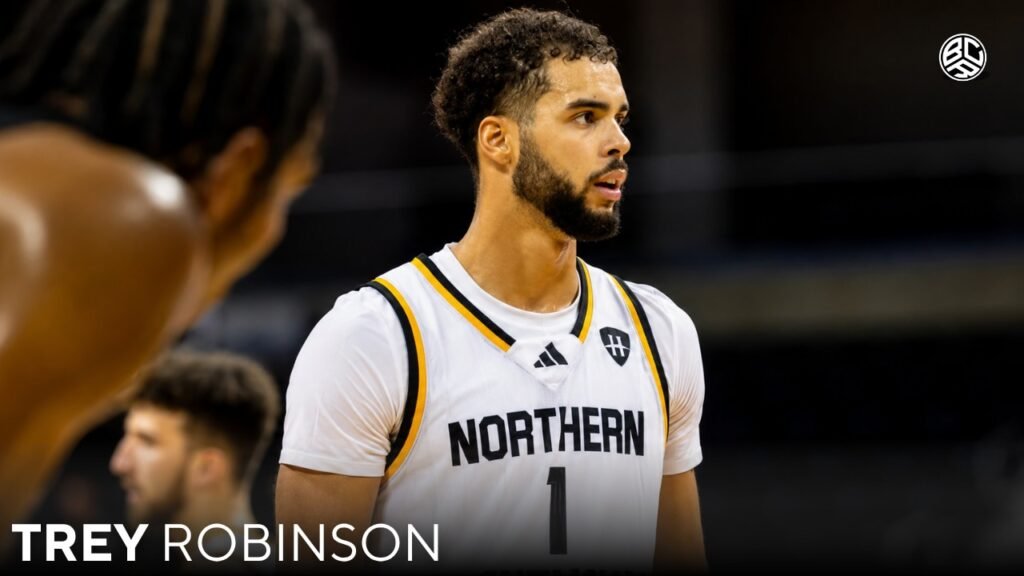
Some college basketball careers announce themselves early: the five-star recruit, the immediate starter, the freshman who arrives already finished. Trey Robinson’s career at Northern Kentucky University took a different shape. He arrived as a reserve, developed season by season, and left five years later as one of the program’s most consistent contributors, having spent a complete collegiate career transforming from a role player into a double-figure scorer.
That arc measured, sustained, built through years of work is worth documenting.
Quick Summary
| Category | Details |
| Name | Trey Robinson |
| Position | Guard |
| Team | Northern Kentucky Norse |
| Hometown | Hamilton, Ohio |
| College Career | 2020–2025 |
| Games Played | 155 |
| Career Points | 1,385 |
| Career Rebounds | 705 |
| Career Assists | 221 |
| Career Steals | 202 |
| Career Averages | 8.9 PPG, 4.5 RPG, 1.4 APG |
| Best Season (2024–25) | 15.5 PPG, 5.9 RPG, 1.9 APG |
| Playing Style | Physical scoring guard, strong rebounder, active defender |
| Career Summary | Developed from a reserve player into Northern Kentucky’s leading scorer and one of the program’s most consistent contributors. |
Background: Hamilton, Ohio to Northern Kentucky
Trey Robinson grew up in Hamilton, Ohio, a city in the southwestern part of the state with a strong tradition of producing athletes. He arrived at Northern Kentucky University wearing number 1, lining up as a guard in the Horizon League’s NCAA Division I men’s basketball program.
Northern Kentucky’s Norse program operates at a competitive Division I level, competing in a Horizon League that includes schools like Oakland, Milwaukee, Youngstown State, Detroit Mercy, and Cleveland State. It is a conference that requires players to contribute across multiple categories. The margin for one-dimensional production is thin, and coaches at this level need guards who can do several things adequately rather than just one thing well.
Robinson proved, over five seasons, that he could do several things.
The Career Arc: From Reserve to Leading Scorer
What makes Robinson’s statistical story compelling is how clearly the improvement shows in the numbers across five seasons.
| Season | Points Per Game | Rebounds Per Game |
| 2020–21 | 5.3 | 2.3 |
| 2021–22 | 4.0 | 3.2 |
| 2022–23 | 7.0 | 3.7 |
| 2023–24 | 11.7 | 7.0 |
| 2024–25 | 15.5 | 5.9 |
This is not a career defined by one breakout year. It is a career defined by consistent upward movement, more points, more rebounds, more minutes, more responsibility, every season. From 5.3 points per game as a freshman to 15.5 as a fifth-year player represents a genuine and earned development rather than circumstance.
Career Totals: The Full Picture
Across 155 games in a Northern Kentucky uniform, Robinson put together a body of work that sits comfortably among the program’s more productive guards in recent memory.
His career totals include 1,385 points, 705 rebounds, 221 assists, and 202 steals. That steal number is worth pausing on 202 career steals reflects active, engaged defense over a sustained period, not the result of gambling for highlights. It indicates a player who was present defensively throughout his career, not just offensively.
His career averages 8.9 points, 4.5 rebounds, 1.4 assists, and 1.3 steals per game on 43.5 percent shooting reflect a player who contributed across multiple categories rather than accumulating numbers in one area at the expense of others. The 29.5 percent career three-point rate tells you he was not primarily a perimeter shooter, and the 67 percent free throw percentage confirms the production came largely from inside work and mid-range scoring rather than long-range output.
The 2024–25 Season: A Career Peak
Robinson’s fifth and final season was his best, and it was not particularly close.
He started 32 of 33 games, averaged 30.6 minutes per night, and posted the strongest numbers of his career across every major statistical category. Fifteen and a half points per game, nearly six rebounds, 1.9 assists, and 1.6 steals with field goal shooting that climbed to 48 percent, the best efficiency of his career.
That shooting number matters. Scoring at 15.5 points per game while converting nearly half of your field goal attempts is efficient production. It means the points came from good shots rather than volume, a marker of a player who has developed genuine skill at creating and finishing.
Several individual games in 2024–25 illustrated the level he was operating at. He scored 24 points with 7 rebounds against Youngstown State and put together 18 points, 5 assists, and 3 steals against Detroit Mercy, a performance that showcased the full range of his contributions. He also logged 31 minutes in the Horizon League Tournament quarterfinal against Cleveland State, stepping up in the games that mattered.
Playing Style: What He Actually Is
Statistical profiles tell you what happened. Playing style analysis tells you how.
Based on his career numbers, Robinson fits the profile of a physical scoring guard who operates most effectively when he can attack off the dribble and create contact rather than spotting up from deep. His below-average three-point percentage but above-average steal numbers suggest someone more comfortable operating in traffic than at range.
The rebound numbers for a guard are notably 4.5 per game for a career, peaking at 7.0 in his junior season and they indicate a player who competes on the glass even when it is not his primary responsibility. Rebounding guards are valuable in Horizon League basketball, where possessions matter and every board has real significance.
He is not a playmaker in the traditional sense 1.4 assists per game over a career is efficient rather than generative but he is an active defender who adds value beyond just scoring.
What the Five-Year Career Represents
It is worth stepping back from the numbers to appreciate what a five-year college basketball career actually involves.
Robinson spent five seasons including years that overlapped with COVID-disrupted scheduling, coaching adjustments, and the shifting roster dynamics that come with the transfer portal era developing his game in the same program, building on the same foundation, and finishing his career as the player his freshman-year self was trying to become.
That kind of sustained commitment to one program and one development path is increasingly rare in modern college basketball. The transfer portal has made it easier for players to move when circumstances feel difficult, and many do. Robinson stayed, improved, and peaked.
Conclusion
Trey Robinson’s career at Northern Kentucky University is the kind of story that does not generate national headlines but holds up clearly under examination. He was a reserve who became a starter, a role player who became a leading scorer, and a guard who finished his career posting 15.5 points, 5.9 rebounds, and nearly two steals per game in Division I basketball.
He did it gradually, visibly, and honestly season after season of incremental improvement that added up to something real.
That is not a minor achievement. In college basketball, where patience and development are tested constantly, it is exactly the kind of career that deserves to be recognized.
NOTE: All statistics sourced from ESPN’s official player profile and career statistics pages for Trey Robinson, Northern Kentucky University.
Discover Also Toriah Lachell: The Curl Specialist Building Her Own Story

M Adnan Akram is the founder and lead writer at Back Casting Room, where he covers celebrity biographies, family histories, and the lesser-known figures behind well-known names. His work focuses on separating verified public information from speculation, drawing on publicly available records, interviews, and credible reporting to build accurate, well-researched profiles.
With a particular interest in entertainment and pop culture, Adnan writes about everything from celebrity net worth breakdowns to the private individuals connected to famous names, the spouses, family members, and background figures whose stories rarely get told in full.
At Back Casting Room, the goal is straightforward: give readers accurate, well-sourced information without the clickbait or unverified claims that often surround celebrity-adjacent stories.