
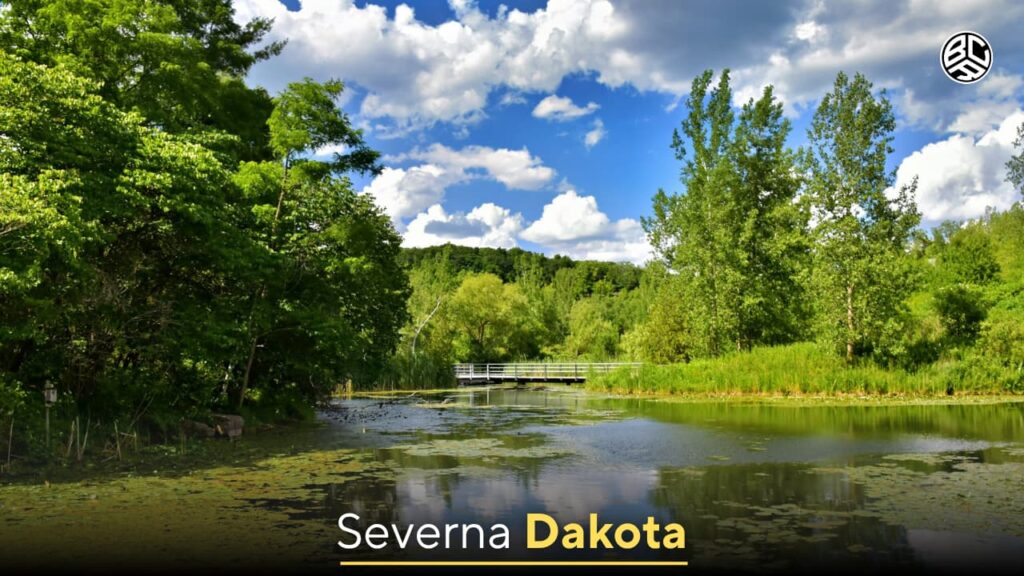
If you’ve searched for Severna Dakota and wondered whether it’s a real place, you’re not alone. The name appears frequently online, particularly on translated or multilingual websites, and it can leave people genuinely confused about what they’re looking at. The short answer is straightforward: Severna Dakota is simply the translation of North Dakota into several Slavic languages, including Serbian, Slovak, and Czech. It is not a separate place. It is not an unofficial region. It is North Dakota, one of the 50 states of the United States.
Once that’s clear, the more interesting question becomes: what is North Dakota actually like? Because for a state that rarely makes international headlines, it’s a genuinely fascinating place, vast, historically rich, economically significant, and dramatically underestimated.
Why the Name Severna Dakota Appears Online
The word “severna” means “northern” in Serbian, Slovak, Czech, and related languages. When these languages translate the name North Dakota, they render it literally Severna Dakota which is a direct word-for-word equivalent. Many websites, mapping platforms, and content aggregators auto-translate place names, which is how the term ends up scattered across the internet in contexts that can make it look like a different or alternative name for a different place.
It isn’t. There is no official geographic or political entity called Severna Dakota in the English-speaking world. If you see it referenced anywhere, it refers to the U.S. state of North Dakota in its translated form.
Where North Dakota Is and What It Looks Like
North Dakota sits in the north-central part of the United States, right on the border with Canada. To the north it shares a border with the Canadian provinces of Saskatchewan and Manitoba. Minnesota lies to the east, South Dakota to the south, and Montana to the west.
The landscape is largely flat, open plains classic Great Plains terrain that stretches in every direction. The state covers approximately 70,698 square miles, making it one of the larger U.S. states by land area, even though its population is relatively small. As of 2024, North Dakota has around 796,000 residents, making it one of the least densely populated states in the country.
The capital is Bismarck, located near the center of the state. The largest city is Fargo, situated on the eastern edge along the Minnesota border, a name many people recognize either from the 1996 Coen Brothers film or from the television series it inspired.
The Climate: Extremes in Every Season
North Dakota has a continental climate, which means it experiences the full range of seasonal extremes without the moderating influence of a large body of water. Summers can be genuinely hot, with temperatures climbing well above 30°C in July. Winters are among the harshest in the continental United States; temperatures can drop below −50°C in extreme cases, particularly in the open plains where wind chill amplifies the cold significantly.
For anyone planning to visit, the warmest and most comfortable window is roughly May through September. Outside that period, the weather becomes a serious practical consideration.
What Drives the North Dakota Economy
Despite its small population, North Dakota punches well above its weight economically. The state is one of the most productive agricultural regions in the entire country. Wheat is the most prominent crop, but corn, soybeans, sunflowers, and livestock farming also contribute significantly to the agricultural output.
Oil and natural gas have reshaped the state’s economy over the past two decades. The Bakken Formation, a vast shale oil deposit beneath the western part of the state, turned North Dakota into one of the top oil-producing states in the U.S. during the fracking boom of the 2010s. Energy remains a cornerstone of the state’s revenue base alongside food processing and related industries.
A Brief History of the State
The land that is now North Dakota was originally inhabited by Native American peoples, most notably the Dakota Sioux, from whom both North and South Dakota take their names. “Dakota” is a Sioux word meaning “allied” or “friendly.”
European American settlement expanded rapidly in the 19th century, driven by the construction of railroads and waves of agricultural homesteading. On November 2, 1889, North Dakota was admitted to the Union as the 39th state, on the same day as South Dakota the two states entered together through the division of the Dakota Territory.
Severna Dakota Is North Dakota and North Dakota Is Worth Knowing
The confusion around the name Severna Dakota is easily resolved once you understand how translation works across Slavic languages. The place is real, well-documented, and entirely ordinary as a U.S. state just known by different names depending on which language you’re reading in.
What’s more interesting is what the state itself actually offers: a vast, quiet landscape shaped by agriculture and energy, a history tied to the indigenous peoples of the Great Plains, and a climate that demands respect. Whether you encountered the name through a translated website or genuine curiosity about the American Midwest, the destination behind it is worth knowing on its own terms.
Discover Also House Khloe Kardashian Built: A Complete Look Inside Her Hidden Hills Mansion

M Adnan Akram is the founder and lead writer at Back Casting Room, where he covers celebrity biographies, family histories, and the lesser-known figures behind well-known names. His work focuses on separating verified public information from speculation, drawing on publicly available records, interviews, and credible reporting to build accurate, well-researched profiles.
With a particular interest in entertainment and pop culture, Adnan writes about everything from celebrity net worth breakdowns to the private individuals connected to famous names, the spouses, family members, and background figures whose stories rarely get told in full.
At Back Casting Room, the goal is straightforward: give readers accurate, well-sourced information without the clickbait or unverified claims that often surround celebrity-adjacent stories.