
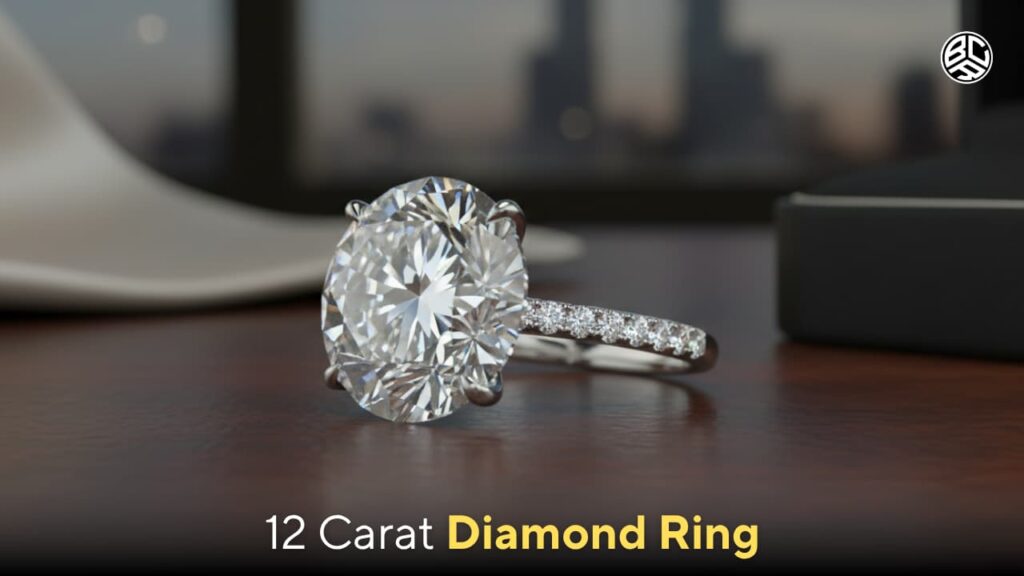
Some jewelry makes a statement. A 12 carat diamond ring makes a declaration.
Few things in the world of fine jewelry command attention quite like a diamond of this size. It sits well beyond the realm of typical engagement rings or anniversary gifts; this is ultra-luxury territory, the kind of piece that gets passed down through generations and makes headlines when it appears at celebrity engagements or auction houses.
But what exactly makes a diamond of this size so special, so rare, and so extraordinarily valuable? Here’s everything worth knowing.
What Does 12 Carats Actually Mean?
The word “carat” trips up a lot of people. It measures weight, not size though the two are closely related for diamonds.
One carat equals 0.2 grams. So a 12 carat stone weighs 2.4 grams. That might not sound like much on paper, but on a finger, it’s a completely different story.
A diamond of this weight is visually massive. Depending on the cut and shape, it can cover up to 80% of the wearer’s finger. It’s the kind of stone that draws eyes from across the room which is precisely why it’s considered a luxury statement piece rather than everyday jewelry.
How Much Does a 12 Carat Diamond Ring Cost?
This is where things get serious.
Natural Diamonds
For a natural 12 carat diamond, prices typically range from $100,000 to well over $1.5 million. High-quality stones with exceptional color and clarity can push into even more extreme territory; some premium examples reach $1 million per carat, putting the total value above $10 million.
To give some real-world context:
- A mid-quality stone might sell for around $341,000
- A high-quality, well-certified stone can reach $1,050,000 or more
The reason prices vary so dramatically comes down to quality factors, which are explored below.
Lab-Grown Alternatives
For buyers who want the visual impact without the natural rarity premium, lab-grown diamonds offer a compelling alternative. A lab-grown 12 carat stone typically costs between $4,500 and $25,500 a fraction of the natural price, with identical chemical and physical properties.
The difference is origin, not quality. Lab diamonds are real diamonds. They simply didn’t form over millions of years beneath the earth’s surface.
What Determines the Price: The 4Cs
Every diamond is evaluated using four key quality factors. At 12 carats, even small differences in these factors can shift the price by hundreds of thousands of dollars.
Cut The Most Important Factor
Cut determines how light moves through the stone and therefore how much it sparkles. A poorly cut large diamond will look dull and lifeless. A well-cut stone of the same size will be breathtaking.
Cut is graded from Excellent to Poor, and for a stone this valuable, anything less than Very Good is worth avoiding.
Color
Diamond color is graded on a scale from D (completely colorless) to Z (noticeable yellow or brown tint). For a 12 carat stone, the ideal range is D through F colorless grades that allow light to pass through with maximum clarity and brilliance.
Clarity
Clarity measures the presence of internal inclusions or external blemishes. Fewer flaws mean a higher grade and a higher price. At this size, inclusions that would be invisible in a smaller stone become more noticeable, making clarity a particularly important consideration.
Carat Weight
Unlike smaller diamonds where price scales somewhat predictably, large diamonds increase in value exponentially with weight. A 12 carat stone is not simply twelve times the value of a 1 carat stone of the same quality, it’s significantly more, because stones of this size are genuinely rare.
Popular Shapes and Settings
Diamond Shapes
- Round The most expensive cut, offering maximum brilliance and sparkle
- Oval Creates the illusion of even greater size; elegant and elongating on the finger
- Cushion Soft, rounded corners with a vintage aesthetic
- Emerald A rectangular step-cut that emphasizes clarity and creates a clean, sophisticated look
Ring Settings
The setting frames the stone and affects both appearance and security.
- Solitaire Lets the diamond speak for itself; classic and timeless
- Halo Surrounds the center stone with smaller diamonds, amplifying its visual presence
- Pavé Small diamonds set along the band add continuous sparkle
- Three-stone A center diamond flanked by two side stones, often chosen for its symbolic meaning
Why These Rings Are So Rare and Special
Diamonds weighing 12 carats or more are extraordinarily uncommon in nature. The overwhelming majority of mined diamonds are small stones of this size that represent a tiny fraction of global diamond production.
This rarity is reflected in everything about how they are bought and sold. Most rings featuring stones of this size are custom-made, designed around the specific characteristics of the individual diamond rather than mass-produced settings.
Celebrity engagement rings in this size range think high-profile proposals that make entertainment news are commonly valued between $750,000 and $2 million or more. These pieces often become heirlooms, held in families for generations as both sentimental objects and financial assets.
Buying Smart: What to Know Before You Invest
A purchase of this magnitude deserves serious due diligence.
Always insist on GIA certification. The Gemological Institute of America is the gold standard for diamond grading. A GIA certificate provides an independent, verified assessment of the stone’s 4Cs and confirms its authenticity.
Prioritize cut over size. A slightly smaller stone with an exceptional cut will outshine a larger stone with a mediocre one every time.
Consider lab-grown seriously. If visual impact matters more than natural origin, a lab-grown stone offers dramatic savings without sacrificing beauty or durability.
Work with a reputable jeweler. At this price point, the expertise and integrity of the person selling the stone matters enormously.
Conclusion
A 12 carat diamond ring sits at the very top of the jewelry world, rare, breathtaking, and genuinely valuable in every sense. Whether it’s the product of millions of years of geological formation or days in a laboratory, a stone of this size carries undeniable presence.
The key is understanding what drives that value. Cut, color, clarity, and carat weight work together to determine whether a stone is worth $100,000 or ten times that. With the right knowledge, the right certification, and the right jeweler, buying a diamond of this caliber becomes a decision made with confidence rather than guesswork.
Discover Also Zendaya Engagement Ring: A Closer Look at the Iconic Jewelry

M Adnan Akram is the founder and lead writer at Back Casting Room, where he covers celebrity biographies, family histories, and the lesser-known figures behind well-known names. His work focuses on separating verified public information from speculation, drawing on publicly available records, interviews, and credible reporting to build accurate, well-researched profiles.
With a particular interest in entertainment and pop culture, Adnan writes about everything from celebrity net worth breakdowns to the private individuals connected to famous names, the spouses, family members, and background figures whose stories rarely get told in full.
At Back Casting Room, the goal is straightforward: give readers accurate, well-sourced information without the clickbait or unverified claims that often surround celebrity-adjacent stories.