
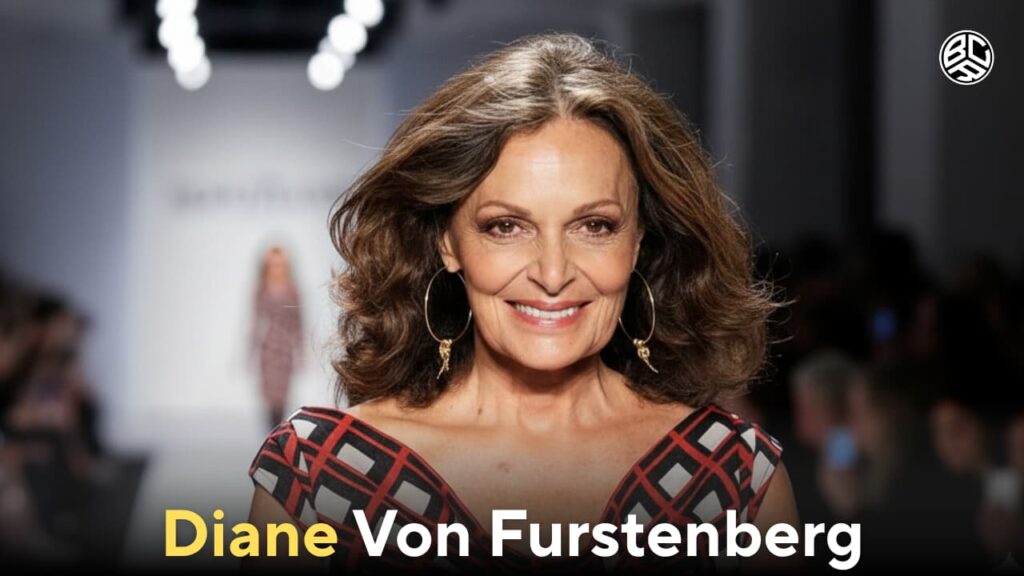
There are very few stories in fashion where a single garment genuinely changed the trajectory of someone’s career, financial life, and cultural impact all at once. Diane von Furstenberg’s wrap dress is one of them. When she introduced it in the early 1970s, it was not just a commercially successful product. It was the foundation of a personal fortune and a global brand that would carry her name for decades.
As of the most widely cited estimates, Diane von Furstenberg net worth stands at approximately $1.2 billion, placing her among the wealthiest fashion designers in the world. Some sources use more conservative valuations and place the figure closer to $300 million to $450 million, reflecting the challenges of estimating wealth tied to a private company and a complex portfolio of real estate and investments. The range itself tells you something about how the fashion business works: when your primary asset is a brand that is not publicly traded, precise numbers are always estimates rather than facts.
What is clear, across all valuations, is that her financial standing reflects a career of genuine entrepreneurial accomplishment, not inherited wealth or a single lucky moment.
Quick Facts
| Category | Details |
|---|---|
| Name | Diane von Furstenberg |
| Net Worth | ~$300M – $1.2B (estimated) |
| Main Source | Diane von Furstenberg (DVF) |
| Known For | Wrap dress (1974) |
| Comeback | Relaunch via QVC |
| Spouse | Barry Diller |
| Assets | Global real estate portfolio |
| Philanthropy | Diller–von Furstenberg Family Foundation |
The Wrap Dress and the Birth of DVF
Diane von Furstenberg launched her eponymous fashion brand in the early 1970s, having arrived in New York from Europe with a small amount of fabric and a clear vision of what she wanted to make. The wrap dress, introduced in 1974, became one of the defining fashion items of that decade. Within two years of its launch, she had reportedly sold more than five million of them, a figure that made her one of the most commercially successful American designers of her era.
The dress was marketed not just as clothing but as a symbol of women’s freedom and self-sufficiency, which connected with a generation of women entering the workforce in large numbers for the first time. That cultural alignment between product and moment is rare, and it generated the kind of brand recognition that money alone cannot manufacture.
The DVF label expanded rapidly in the 1970s across clothing lines, accessories, and beauty products, with licensing deals extending her reach far beyond what she could produce directly. Licensing, in particular, became a significant income stream that allowed the brand to generate revenue from manufacturers and retailers globally without requiring equivalent capital investment from her own business.
The 1980s Decline and the 1990s Comeback
The DVF brand faced serious difficulties in the 1980s. Changing fashion tastes, overextension of the brand through licensing, and increased competition contributed to a period of decline that saw the label lose much of its earlier prominence. By the late 1980s, she had stepped back from active fashion leadership and spent time in Europe.
The recovery, when it came in the 1990s, was deliberate and well-executed. She relaunched the wrap dress through QVC, the television home shopping channel, and the response demonstrated that the product and the brand had retained their cultural resonance with consumers even after years of reduced visibility.
The QVC relaunch was also strategically important in a way that is easy to underestimate. Television retail in the 1990s reached a mass audience in their homes at a price point that made luxury-adjacent fashion accessible, and it positioned the DVF brand for the kind of broad commercial recovery that could sustain significant long-term growth.
Following that relaunch, she rebuilt the global licensing framework, re-entered major retail partnerships, and established DVF as a modern fashion house with genuine international reach. The recovery was substantial enough to generate the kind of cumulative wealth that can support a billionaire-level valuation.
A Substantial Real Estate Portfolio
Significant portions of her estimated net worth are tied to real estate holdings, which represent a common and sensible way for high-net-worth individuals to store and grow wealth outside of their primary business.
Her portfolio includes properties across multiple cities and countries. She owns a New York building that also serves as the DVF company headquarters, a Beverly Hills estate, a Connecticut countryside estate, and a Paris apartment. In 2024, she reportedly purchased a Miami waterfront property for approximately $45 million.
Real estate at this level is not passive. It reflects active investment decisions about markets, timing, and property types, and the appreciation of high-value properties in cities like New York, Beverly Hills, and Miami has historically been substantial over the long periods she has held many of these assets. Including real estate in any honest assessment of her net worth is essential because it contributes meaningfully to the overall figure.
Marriage to Barry Diller and Combined Financial Influence
Diane von Furstenberg married media executive Barry Diller, whose own estimated net worth approaches $5 billion, built through decades of leadership at major entertainment and media companies. Their finances are separate, and her wealth is her own. But the partnership has clearly been beneficial in terms of business opportunities, investment scale, and access to networks that operate at a level very few individuals can reach.
When two people with significant independent resources operate in overlapping financial and business environments, the combined effect on each person’s opportunities and reach is greater than either would have alone. That dynamic has almost certainly influenced the scale and quality of her investments over the years, even without any direct financial merger.
Licensing, Investments, and Ongoing Income Streams
One of the less-discussed aspects of how she built her fortune is the role of licensing in generating income that does not require her direct involvement in production. Fashion licensing deals allow other manufacturers to produce goods under the DVF label in exchange for royalty payments, which flow back to the brand as relatively passive income.
Over several decades, the cumulative effect of licensing agreements across clothing, accessories, beauty, and other product categories has been significant. Combined with collaborations with major retail brands, publishing ventures, and other media partnerships, these arrangements have created a diversified income structure that is less volatile than a business dependent on any single product or season.
Philanthropy: Spending That Reflects Scale
The Diller-von Furstenberg Family Foundation, co-founded with Barry Diller, has donated more than $130 million toward public projects, including significant contributions to parks and public spaces in New York City. The High Line, one of the most celebrated urban park projects in the United States, benefited substantially from their foundation’s support.
It is worth noting that philanthropic spending at this level is only possible when the underlying financial position is very strong. Giving away $130 million while maintaining the lifestyle and asset base visible in public reporting about her life requires a net worth that can absorb that kind of contribution without meaningful impact on day-to-day financial security. It does not prove a specific net worth figure, but it is consistent with the upper range of the estimates.
Why Net Worth Estimates Vary So Much
| Factor | Impact on Estimate |
| DVF brand valuation | Private company no public market price available |
| Ownership stake in DVF | She does not own 100%, diluting personal share |
| Real estate pricing | Fluctuates with market conditions |
| Source methodology | Different analysts use different financial models |
| Investment portfolios | Private investments are not publicly disclosed |
The result is a genuine range: conservative analysts produce figures in the $300 million to $450 million territory, while more generous valuations of the DVF brand and real estate portfolio support the approximately $1.2 billion figure. Both can be simultaneously reasonable, depending on assumptions made about private assets.
Conclusion
Diane von Furstenberg’s net worth, wherever it falls within the estimated range, is the product of more than fifty years of entrepreneurial persistence, creative vision, and strategic business management. She built a brand, lost it, rebuilt it more strongly, diversified into real estate and investments, and used philanthropy at a scale that reflects genuine long-term financial security.
The wrap dress was the beginning, but it was never the whole story. What came after it, including the global licensing network, the New York real estate portfolio, the QVC relaunch that turned a cultural memory into a modern commercial brand, and the investment decisions made over decades alongside one of America’s most successful media executives, is what actually produced the fortune.
The precise number may never be publicly confirmed. But the trajectory that produced it is clear, well-documented, and genuinely impressive.
Discover Also Hannah Ferrier Net Worth: How the Below Deck Star Built a Multi-Million Dollar Fortune

M Adnan Akram is the founder and lead writer at Back Casting Room, where he covers celebrity biographies, family histories, and the lesser-known figures behind well-known names. His work focuses on separating verified public information from speculation, drawing on publicly available records, interviews, and credible reporting to build accurate, well-researched profiles.
With a particular interest in entertainment and pop culture, Adnan writes about everything from celebrity net worth breakdowns to the private individuals connected to famous names, the spouses, family members, and background figures whose stories rarely get told in full.
At Back Casting Room, the goal is straightforward: give readers accurate, well-sourced information without the clickbait or unverified claims that often surround celebrity-adjacent stories.