
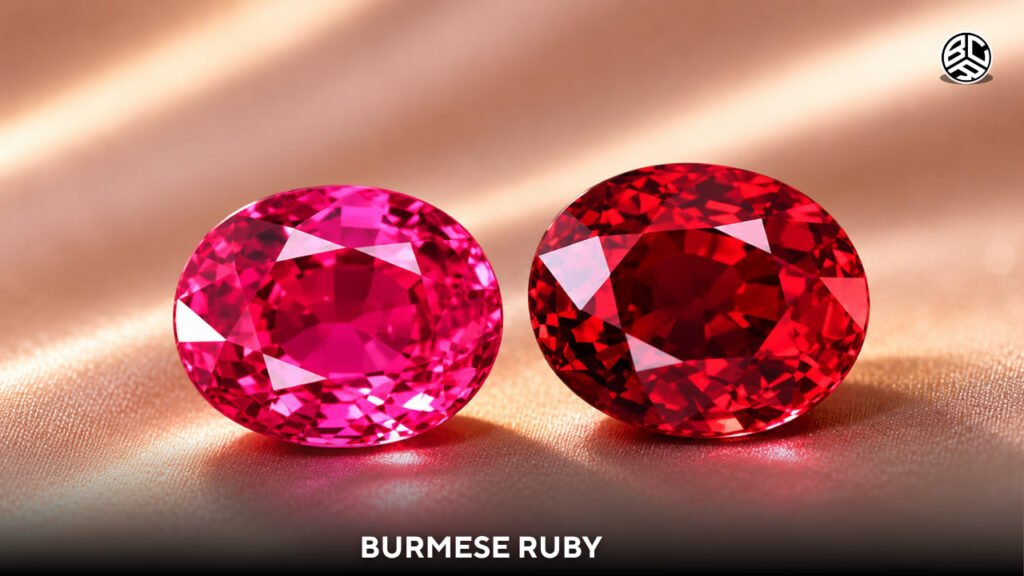
There are rubies, and then there are Burmese rubies. In the world of colored gemstones, that distinction matters enormously the difference between a beautiful stone and one that commands millions of dollars per carat at auction.
For centuries, Myanmar (formerly Burma) has produced rubies that gemologists, collectors, and luxury jewelers regard as the finest on Earth. The combination of color, rarity, and history that comes with a genuine Burmese stone has elevated it to a category of its own that other ruby-producing countries have never quite managed to match.
What Is a Burmese Ruby?
At its most basic, a Burmese ruby is a ruby mined in Myanmar. Like all rubies, it is a variety of the mineral corundum aluminum oxide colored red by the presence of chromium. It registers a 9 on the Mohs hardness scale, making it one of the hardest natural substances on Earth, second only to diamond.
What separates the Myanmar variety is not just geography. It is chemistry. Rubies from the legendary Mogok Stone Tract in northern Myanmar tend to have high chromium content and very low iron levels, a combination that produces both an exceptional red color and a remarkable optical phenomenon called fluorescence.
The Mogok Stone Tract: Where the Finest Rubies Come From
Mogok is not a recent discovery. Mining records from the region stretch back to at least the 15th century, and the area has been supplying the world’s finest rubies for longer than most modern nations have existed.
The geological conditions in Mogok are unusual; the rubies form in marble rather than the basalt typically associated with ruby deposits elsewhere. Marble-hosted rubies tend to have that lower iron content that enables the fluorescence characteristic of top Burmese stones.
Myanmar also has other ruby-producing areas, most notably Mong Hsu, which was commercially discovered in the 1990s. Mong Hsu stones are more abundant but typically require heat treatment and do not reach the same quality ceiling as the best Mogok material.
Pigeon’s Blood Red: The Color That Sets the Standard
Of all the qualities that define a premium Burmese ruby, color is the most important. And at the top of the color hierarchy sits one of the most evocative terms in all of gemology: Pigeon’s Blood Red.
The phrase describes a very specific hue, a vivid, highly saturated red with a slight blue undertone that gives the stone a warm intensity without veering into pink or purple. In daylight, the best examples appear to glow from within, a quality that comes directly from the fluorescence that iron-poor, chromium-rich Myanmar rubies produce.
Not every Burmese ruby earns this designation. The term is reserved for stones that meet strict color criteria, typically confirmed by a reputable laboratory. Achieving it requires the right chemistry from the mine, combined with expert cutting to maximize the color’s expression.
Below Pigeon’s Blood on the scale, rubies are graded through various levels Vivid Red, Intense Red, Strong Red, and down to purplish or brownish reds that carry significantly lower values. Color is everything in this market.
Treated vs. Untreated: The Distinction That Drives Price
The majority of rubies on the market including many from Myanmar undergo heat treatment before they are sold. Heat treatment is a widely accepted practice in the gemstone industry. It is used to improve color, reduce the visibility of inclusions, and increase transparency. A well-executed heat treatment does not make a ruby fake; it makes it more commercially appealing.
But untreated rubies are in a different category entirely.
A natural, unheated Burmese ruby with excellent color and clarity is among the rarest gemstones on the planet. In the fine gem market, untreated origin can multiply the value of an otherwise similar stone by a factor of three, five, or more. This is why laboratory certification is so important; it is the only reliable way to determine treatment status, since the evidence is microscopic and not visible to the naked eye.
Reputable laboratories including the GIA, SSEF, and Gübelin Gem Lab are considered the gold standard for origin and treatment verification.
Famous Stones That Illustrate the Value
The record books for ruby auctions tell the Burmese ruby story better than any price chart.
The Sunrise Ruby, a 25.59-carat Mogok stone with Pigeon’s Blood color and no evidence of heat treatment, sold at Sotheby’s Geneva in 2015 for $30.3 million. At the time, it set the world record for a ruby sold at auction, and the price per carat it achieved was extraordinary even by the standards of exceptional colored gemstones.
Then there is the Rosser Reeves Star Ruby, a 138.7-carat Burmese stone famous for its perfectly centered six-rayed star, now on display at the Smithsonian National Museum of Natural History. And the Liberty Bell Ruby carved from an 8,500-carat Burmese rough, shaped into a miniature Liberty Bell, and stolen in a 2011 jewelry heist from which it has never been recovered.
Each of these stones represents something different, but all of them share the Mogok origin that defines the pinnacle of ruby quality.
How Burmese Rubies Are Used in Fine Jewelry
The finest examples of these stones find their way into pieces by the world’s most celebrated jewelry houses. Cartier, Van Cleef & Arpels, Harry Winston, Bulgari, and Graff have all built celebrated pieces around Burmese rubies often pairing them with diamonds in settings that let the stone’s color dominate.
They appear in engagement rings, royal jewelry, high-end necklaces, earrings, and investment-grade pieces designed to hold or increase their value over time. For collectors who treat gemstones as an alternative asset class, a certified unheated Burmese ruby of fine quality occupies a position similar to a blue-chip stock with a track record of holding value and a market that understands what it is worth.
The Ethical Dimension
No honest discussion of these gems can ignore the complications surrounding Myanmar’s gem trade. The country’s gemstone industry has faced sustained scrutiny due to human rights concerns, environmental impacts, and the involvement of the military in parts of the trade.
Several countries have imposed import restrictions or sanctions on Myanmar gemstones at various points. For buyers, this makes provenance documentation not just a gemological concern but a legal and ethical one. Reputable dealers provide documentation confirming origin and legal sourcing a standard that serious collectors should insist on.
Conclusion
The Burmese ruby’s reputation did not emerge from marketing. It was built over centuries of production in one of the world’s most remarkable geological environments, refined by the preferences of collectors and jewelers who recognized that Mogok produced something different from anywhere else.
Pigeon’s Blood color, remarkable fluorescence, and extreme rarity in fine untreated examples are the qualities that keep the Burmese stone at the top of the ruby market regardless of what other countries produce. Other rubies are beautiful. The finest ones from Myanmar are something else.
Discover Also ELLIATT Dress: The Brand Everyone Is Wearing to Weddings

M Adnan Akram is the founder and lead writer at Back Casting Room, where he covers celebrity biographies, family histories, and the lesser-known figures behind well-known names. His work focuses on separating verified public information from speculation, drawing on publicly available records, interviews, and credible reporting to build accurate, well-researched profiles.
With a particular interest in entertainment and pop culture, Adnan writes about everything from celebrity net worth breakdowns to the private individuals connected to famous names, the spouses, family members, and background figures whose stories rarely get told in full.
At Back Casting Room, the goal is straightforward: give readers accurate, well-sourced information without the clickbait or unverified claims that often surround celebrity-adjacent stories.